

Dragon tattoos aren't like other tattoo designs. Most symbols mean roughly the same thing everywhere: a rose is a rose, a butterfly is a butterfly. Dragons are different. In China, they're emperors. In Japan, they're water spirits. In Wales, one sits on the national flag, and in England it's the beast St George slew. In Mesoamerica, they're gods. Same creature, seven very different stories depending on where you're from.
That makes the dragon one of the most powerful designs you can wear, and one of the easiest to get wrong. It isn't sacred or off-limits. But if you wear a symbol without knowing what it says, you end up with a tattoo that looks good and means nothing. Below you'll find what each dragon stands for, the mistakes people make, and how to work out which one is yours.
East and West: two very different animals
If you only remember one thing about dragon tattoos, make it this. Eastern and Western dragons aren't variations of the same creature. They're opposites.
Eastern dragons (Chinese, Japanese, Korean, Vietnamese) are benevolent. They're wise, powerful guardians linked to water and weather. They have long serpentine bodies, no wings (they fly by magic), flowing whiskers and elaborate scales. They bring luck, rain and prosperity, and nobody fights an Eastern dragon: you honour it.
Western dragons, from medieval Europe and Norse myth, are the enemy. They guard treasure, breathe fire and terrorise villages, and knights kill them to prove their courage. Picture Game of Thrones: four legs, wings, built for a fight. Their symbolism is about overcoming something. A Western dragon tattoo usually says "I fought something and won."
Britain is an interesting case because it has both stories on its own soil. The Welsh dragon is a symbol people fly with pride. The English one is the monster their patron saint killed. More on both below.
Modern tattoos mix the two all the time. You'll see winged Western dragons with an Eastern calm, or Japanese serpents drawn with a darker edge. That's fine, as long as you know which language you're speaking.
Seven cultures, seven dragons
Chinese (Long)

Chinese dragons came first, and every other Eastern tradition borrowed from them, which is why the Chinese dragon (Long) is the reference for all the others. It's a regulator. It controls water, weather and the seasons. It doesn't destroy anything, it keeps things in balance.
Chinese mythology names several types of dragon, each with its own job:
- Tianlong, the celestial dragon, guardian of the gods and the heavens
- Dilong, the earthly dragon, ruling rivers and seas
- Shenlong, the spiritual dragon in charge of wind and rain (the farmer's dragon)
- Longwang, the dragon king, lord of the oceans and storms
Chinese dragons have four or five claws. Five were historically reserved for the emperor, and anyone else wearing a five-clawed dragon risked execution. Four claws were for the nobility, three for commoners. For real imperial weight, go for five. For something more grounded, four.
They're almost always shown with the pearl of wisdom, either holding it, chasing it or guarding it. The pearl is the point of the whole image. It stands for enlightenment, prosperity and the thing worth pursuing.
Japanese (Ryujin)

Japanese dragons grew out of Chinese ones but moved closer to water. They have three claws instead of five and feel less imperial, more meditative. In irezumi, the Japanese tattoo tradition, dragons anchor full back pieces and sleeves, with the body flowing in one long movement between waves and clouds.
As in China, Japanese mythology has several types:
- Ryujin, literally "dragon god", ruler of the sea and the most common tattoo dragon
- Seiryu, the Azure Dragon of the East, one of the four celestial creatures and guardian of spring
- Yamata no Orochi, the eight-headed dragon slain by the storm god Susanoo. A rare choice, usually made by people who know Japanese mythology well
A note on colour. Traditional irezumi uses a deep blue-black ink, which is exactly the shade jagua develops in the skin. A temporary dragon sold as "pure black" is in fact further from the tradition than blue-black, which is worth knowing if irezumi is the look you're after.
Korean (Yong)
The Korean dragon (Yong) is close to the Chinese one but has its own character. It's a lucky creature linked to the sky, rivers and lakes. In Korean folklore, Yong protects kings and brings rain, and farmers called on dragons in times of drought.
What sets it apart is the yeoiju, the orb it's often shown holding. It grants wishes, but only to the virtuous. Korean dragons are also tied to the imugi, lesser dragon-serpents that must live a thousand years before they can become true Yong. If you have Korean roots, a Yong carries a different weight from a generic "Asian" dragon.
Vietnamese
Vietnam is one of the few countries whose founding myth is built on a dragon: a dragon father (Lạc Long Quân) and a fairy mother (Âu Cơ). So the dragon isn't just a symbol there. It's part of the national identity.
Vietnamese dragons are usually drawn in a tight S-shape, surrounded by thunder and lightning. They stand for nobility, power and the protection of the dynasty, and the old Vietnamese dynasties used the dragon as their imperial emblem. It's a tradition in its own right, with its own rules.
Celtic and Welsh
Celtic dragons are made of interlocking knotwork. The body forms endless loops with no beginning and no end, and that's the meaning: the cycle of life, the eternal soul, the link between earth and sky. You'll find them on crests and carvings across Ireland, Scotland and Wales.
Then there's the one most people in Britain already know: Y Ddraig Goch, the Red Dragon on the flag of Wales. Its best-known story comes from the Historia Brittonum, written in the early 9th century. Two dragons, one red and one white, fight beneath the hill of Dinas Emrys in Snowdonia, and the red one wins. The red dragon was read as the Britons and the white one as the invading Saxons. The banner has been carried for centuries and became the official flag of Wales in 1959.
As a tattoo, the Welsh dragon says something very specific about roots and pride, about a nation that kept its language and identity. If you're Welsh or have Welsh family, this is your dragon, and probably the only one on this list you'll be asked about at a rugby match. For Scottish or Irish heritage, Celtic knotwork dragons are the closer match.
Aztec and Mesoamerican (Quetzalcoatl)
Quetzalcoatl, the feathered serpent, isn't quite a dragon in the Eastern or European sense, but he's the closest Mesoamerican equivalent. Half snake and half bird, he was a major god of the Aztec, Maya and Toltec world. He gave humanity maize and invented the calendar, and in some versions he created the world.
Quetzalcoatl designs combine a serpent's body with a bright feathered crest, which you won't see anywhere else in dragon imagery. For people with Mexican, Guatemalan or Central American roots, this is the dragon that belongs to them.
European and medieval (and St George)
These are the dragons of Beowulf, Tolkien and George R.R. Martin: winged, fire-breathing and hostile. In England the most famous of all is the one St George killed. He's the patron saint of England, his red cross is the English flag, and his feast day falls on 23 April. In his story the dragon is the obstacle you face down so everyone else can live.
As a tattoo, this dragon is about overcoming. The dragon you slew can be the addiction you beat, the version of yourself you left behind or a real obstacle you got past. Look for large bat-like wings on top of four legs, a muscular build, sharp teeth and claws, and a dragon usually caught breathing fire or curled around a pile of treasure it has no intention of sharing. Think Smaug, the Hungarian Horntail, or any of the dragons in House of the Dragon.
The cultural respect question
This comes up all the time, usually as "can I get a Japanese dragon if I'm not Japanese?"
The short answer is yes, provided you do your homework. Dragon symbolism has travelled the world for centuries. Japanese tattoo masters have tattooed Westerners with irezumi designs for well over a hundred years, and Chinese tattoo culture is open to dragon imagery. Most people from these cultures don't see dragon tattoos as sacred or off-limits.
It becomes a problem when you:
- use Japanese or Chinese characters without checking the translation. The internet is full of people who thought their tattoo said "strength" when it said "soup", so ask a native speaker before you commit
- describe the design as exotic, mystical or, worst of all, "oriental"
- invent a meaning. Saying your dragon represents "the warrior spirit of ancient Asia" when you found it on Pinterest isn't depth, it's fancy dress
- mix symbols from several cultures without knowing what they mean. A Japanese dragon with Mandarin characters and Korean motifs is cultural word salad
A simple test: if someone from that culture asked why you chose this design, could you give a real answer beyond "it looks good"? If so, you're fine. If not, spend a week reading before you sit in the chair.
From koi to dragon

Of all the dragon stories, this one hits hardest. A Chinese legend tells of koi swimming up the Yellow River towards a huge waterfall called the Dragon Gate. Most of them give up, and most of those who try fall back. The few that reach the top are turned into dragons on the spot.
As a tattoo, it means what it sounds like: perseverance, and the reward for carrying on when most people stop. You'll see it on people marking a real change, like finishing a degree after years of setbacks, getting sober, coming through grief, rebuilding after a divorce or building something from nothing. You were one thing, you got through the waterfall, and you came out as something else.
Koi-to-dragon designs often show the change happening, with a koi body and a dragon's head, a dragon rising out of the koi, or the two side by side. They work well on forearms, calves and back pieces, where there's room for the upward movement.
Dragons in pop culture, and what that does to the meaning
Few people in the UK come to dragon tattoos through ancient mythology. They come through Tolkien, Miyazaki, George R.R. Martin, Harry Potter and Dragon Ball. That's fine, because pop culture has kept these traditions alive for a century. It does mean some dragons now carry a pop-culture meaning more than a cultural one.
| Pop culture dragon | Tradition behind it | What it says as a tattoo |
|---|---|---|
| Haku (Spirited Away) | Japanese Ryujin (water god) | Nostalgia, childhood, gentle power |
| Shenron (Dragon Ball) | Chinese Shenlong | Wishes, ambition, anime nostalgia |
| Hungarian Horntail (Harry Potter) | Western medieval | Facing an impossible task and getting through it |
| Smaug (The Hobbit) | Western medieval | Greed, power, the dragon as obstacle |
| Drogon (Game of Thrones / House of the Dragon) | Western fantasy | Raw power, loss, a political warning |
| Toothless (How to Train Your Dragon) | Western, reimagined | Loyalty, an unlikely friendship |
A dragon inspired by a film or a series is perfectly legitimate, as long as you're honest about it. A Haku tattoo because you loved Spirited Away as a kid is a better story than pretending you discovered ancient Shinto, and people respect the honest version.
Dragon colours and what they mean
In Eastern traditions, colour carries specific meanings:
| Colour | Meaning | Tradition |
|---|---|---|
| Black | Wisdom, experience, respect for elders | Chinese (north, winter) |
| Red | Passion, luck, celebration | Chinese, and the Welsh national dragon |
| Blue / Green | Compassion, growth, calm | Chinese (east, spring) |
| Gold / Yellow | Imperial power, wealth, wisdom | Chinese (reserved for the emperor) |
| White | Purity, transformation, ancestral wisdom | Chinese (death and rebirth) |
A jagua temporary tattoo gives you a deep blue-black, the traditional irezumi colour, which reads as classic tattoo ink and suits every style. If you're planning a permanent piece in colour later, the blue-black version shows you whether the design and placement work before you pay for the colour.
Common mistakes to avoid
People regret dragon tattoos more often than most designs, because the mistakes tend to be cultural rather than visual. You won't see them, but anyone who knows the tradition will.
- Mistranslated characters. Don't get Chinese or Japanese text tattooed unless a native speaker has checked it. Not Google Translate, and not your tattoo artist unless they're a native speaker. Post it on r/translator and wait for three independent confirmations.
- A dragon facing down. In Chinese tradition, dragons should always rise. A dragon heading downwards is considered bad luck because it reverses its natural path towards the heavens, and anyone familiar with the tradition will notice straight away.
- Mixing up the claws. A Japanese dragon has three claws, a Chinese one four or five. Mix them and you end up with a hybrid that belongs to neither tradition.
- Confusing the Welsh and Chinese red dragons. They're completely different creatures. The Welsh dragon has wings and four legs and is European in style, while the Chinese red dragon is serpentine and Eastern.
- The "exotic Asian" label. If you catch yourself calling your dragon "mystical", "oriental" or "exotic", stop. Use the name of the actual culture instead: Chinese, Japanese, Korean.
- Going too small. Dragons lose their detail below a certain size. A 5×5 cm dragon can work in tribal or fine-line styles, but a detailed Japanese Ryujin at that size will look muddy. If you want detail, give it room.
Dragon styles
Japanese irezumi

This is the style most people picture when they hear "dragon tattoo". A serpentine body, detailed scales, three claws and flowing whiskers, always framed by waves, clouds or other natural elements. Irezumi dragons are made for long compositions such as back pieces, sleeves and thighs, and masters like Horiyoshi III have made it one of the most respected traditions in tattooing.
Chinese imperial
More ornate than the Japanese style, with five claws, a longer body and the pearl of wisdom as the focal point. The dragon is traditionally shown rising. It suits the forearm, where the long shape follows the line of the arm, or a piece that wraps from the shoulder to the chest.
Tribal and blackwork

Tribal strips the dragon back to its outline: bold black lines, no shading, strong silhouettes. It works at any size and pairs well with other tribal designs. It also ages better than detailed realism, since there are no fine details to blur over the years.
Celtic knotwork
Interlocking lines form the dragon's body in endless loops. These designs are compact and symmetrical, often circular or rectangular, and work as an upper-arm band, a chest piece or on the shoulder. They're the natural choice for Welsh, Scottish or Irish heritage.
Western realistic
This is the fantasy-novel dragon, winged, muscular and breathing fire. It works in black-and-grey realism or in neo-traditional with bold colour. It needs space, so think back piece, full thigh or a large forearm, because the detail is what makes the style. If you go realistic, go big.
Best placements
Back

The back is the largest uninterrupted area of the body, ideal for sprawling Eastern dragons with waves, clouds and full compositions. Traditionally, a dragon on your back watches over you, so the placement adds to the protective meaning. The back also holds a jagua stain longer than most areas, thanks to thicker skin and little friction.
Forearm

This is the most natural spot for an Eastern dragon, because the long shape of the forearm matches the serpentine body. The inner forearm is personal: you see it, and so do the people close to you. The outer forearm is more of a public statement, and it's where people will ask "is that real?"
Chest
A dragon over the heart reads as a guardian. Dragons across the chest, or curling from one shoulder to the opposite ribs, make striking compositions. It's also where Japanese chest panels (munewari) traditionally begin before running down the torso.
Calf
Calves suit vertical compositions, with dragons rising through clouds or waves or coming down like a Japanese scroll. They're easy to cover with trousers and easy to show in shorts or a skirt, so they're a good pick if you need to stay discreet at work.
Shoulder
You can go for a compact dragon on its own, or a design that wraps from the shoulder to the chest or upper back. There's little friction, the stain holds well, and it works with most clothes.
Spine
A dragon running down the spine is one of the most striking placements there is, elegant and serious, especially in Japanese style. It's worth testing with a temporary tattoo first. You won't see it yourself every day, so living with it for a couple of weeks tells you whether you really want it long term.
Are dragon tattoos a cliché?
The question comes up, usually from people who've never looked closely at one.
Dragons are among the most tattooed designs in the world. That only makes them a cliché if popular has to mean shallow, and nobody says that about roses, the most tattooed flower there is.
What separates a clichéd dragon from a classic one is how specific it is. A generic tribal dragon copied from a flash sheet doesn't say much, whereas a Japanese Ryujin coiling through waves, placed and composed with care, says a lot about the person wearing it. It's the same animal with a different intention. The cliché comes from picking a dragon without thinking about which one, why and how.
What it costs
Permanent dragon tattoos sit at the pricier end of tattooing, because size and detail count for more than with simpler designs. As a rough guide, most UK studios have a minimum charge of around £50 to £100 and an hourly rate of roughly £80 to £150, with London at the top end. That puts a small black-and-grey dragon at around £100 to £250, a medium forearm piece at roughly £300 to £600, and a full Japanese back piece well into the thousands over several sessions. Colour adds time, so it adds cost.
A jagua temporary dragon costs from £8 for the smaller designs, £13 to £15 for medium and long formats, and £18 for the largest. You can try several designs, placements and sizes for less than an hour in the studio chair.
Try it before you commit
Dragons are high-stakes tattoos. They tend to be bigger, more expensive and spread over more sessions than other designs, and they carry cultural weight. That's why they're the ones people regret most when they choose badly, and why testing the design on your own body first is simply common sense.
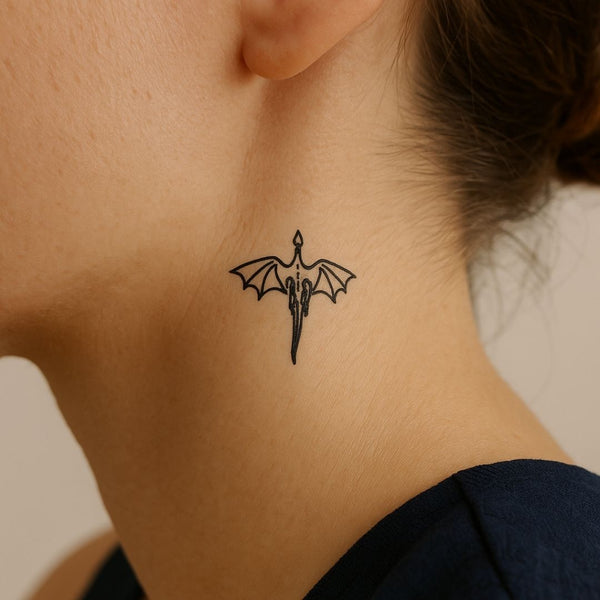
Our dragon temporary tattoos use jagua, a natural fruit-based ink that stains the skin the same deep blue-black the irezumi tradition has used for centuries. It lasts 1 to 2 weeks, it's waterproof and it fades on its own, so you get to see how the design sits on your body, whether the placement feels right and whether you still love it on day ten. Then you either go to the studio knowing what you want, or you keep wearing the temporary version.
Have a specific design in mind, like your own drawing, an artist's sketch or the dragon from your family crest? You can upload it and have it printed in jagua ink, from 3 copies.
Wear it before you ink it.
Japanese, Chinese, tribal or celestial dragons in real jagua ink. They look like irezumi, last 1 to 2 weeks and fade on their own.
Free UK delivery over £39 · No customs charges: the price at checkout is the price you pay
Frequently asked questions
What does a dragon tattoo mean?
It depends on the culture. Eastern dragons (Chinese, Japanese, Korean, Vietnamese) stand for wisdom, protection, prosperity and harmony with nature. Western dragons (European, Norse) represent power, conquest and forces to overcome. The Welsh dragon is a symbol of national pride and roots.
What does the Welsh dragon tattoo mean?
Y Ddraig Goch, the red dragon on the flag of Wales, stands for Welsh identity, pride and resilience. In the legend told in the 9th-century Historia Brittonum, a red dragon defeats a white one beneath Dinas Emrys, which was read as the Britons overcoming the Saxons. As a tattoo, it's a way of wearing your roots.
What's the difference between Japanese and Chinese dragon tattoos?
Count the claws. Japanese dragons have three per foot, Chinese dragons four or five (five were historically reserved for the emperor). Japanese dragons are usually shown in water or clouds and stand for protection. Chinese dragons often hold or chase a pearl of wisdom and stand for imperial power.
Is it cultural appropriation to get a Japanese or Chinese dragon tattoo?
Usually not, if you do your homework. Dragon symbolism has been shared around the world for centuries. It becomes a problem if you use characters nobody has checked, call the design exotic, or mix symbols from different cultures without knowing what they mean. If you can explain why you chose this particular dragon beyond "it looks good", you're fine.
What does a koi dragon tattoo mean?
A Chinese legend says koi that swim upstream and leap the Dragon Gate waterfall turn into dragons. As a tattoo, it means perseverance: you got through something most people give up on and came out changed. It's a popular choice to mark a recovery, a career change or the end of a hard period.
Where is the best placement for a dragon tattoo?
Dragons need space. The back, forearm, chest and calf are the most popular spots, and serpentine Eastern dragons look best along long areas. In Chinese tradition dragons should face upwards, because a dragon facing down is considered unlucky.
Are dragon tattoos a cliché?
Popular doesn't mean clichéd. Dragons are among the most tattooed designs in the world because their symbolism is rich and works across seven cultures. What makes one a classic is choosing which dragon, why and how.
What do dragon tattoo colours mean?
In Eastern tradition, black stands for wisdom, red for passion and luck, blue for compassion, green for growth, gold for imperial power and white for purity and transformation. Western traditions are less strict about colour, although red usually means fire and power, and it's the colour of the Welsh dragon.
How much does a dragon tattoo cost in the UK?
As a rough guide, a small permanent black-and-grey dragon costs around £100 to £250, a medium forearm piece roughly £300 to £600, and a full Japanese back piece runs into the thousands over several sessions. A jagua temporary dragon is an easy way to test size and placement first, or to wear your own design as a custom jagua tattoo.
How long does a temporary dragon tattoo last?
7 to 14 days, depending on placement and aftercare. The back, chest and upper arms hold the stain longest. The colour develops over 24 to 48 hours, so don't judge it on day one. Full duration guide →