

Every lotus tattoo tells the same story before it says anything else: the flower grows out of mud. Its roots sit in dark, stagnant water, and the bloom comes up untouched by any of it. That's the whole symbol in one image: beauty that came through something, not around it.
Which is exactly why the lotus became one of the most tattooed flowers in the world, and why it deserves better than the postcard version. This guide covers what the lotus actually means, the question everyone quietly types into Google (is it disrespectful to wear one?) and the styles where the flower does its best work. Honestly, as always.
What a lotus tattoo really means
Growth through hardship is the core. In Buddhist tradition the lotus stands for purity of mind rising above attachment: the flower opens clean no matter what it grew through, and the Buddha is often depicted seated on one. In Hindu iconography the padma accompanies deities like Lakshmi and carries ideas of divine beauty and spiritual awakening. Ancient Egypt read its own version in the blue lotus, which closes at night and opens with the sun: rebirth, every single morning.
Strip away the theology and one meaning survives every culture: you can come from the mud and still bloom. That's why the lotus is the flower people choose after recoveries, endings, and hard-won new chapters. It's less romantic than the rose and more personal. A rose is usually about someone else; a lotus is almost always about you.
Is a lotus tattoo good or bad? The respect question, answered
The most-asked question about this flower, so here's a straight answer. The lotus is not a closed symbol. Unlike sak yant — the sacred Thai tattoos traditionally applied by monks, with rules about who wears them and how — the lotus flower itself appears across Buddhist, Hindu, Egyptian and simply botanical contexts. Wearing one as a symbol of growth is not appropriation; it's what the symbol has meant to millions of people for millennia.
Context still matters, and two rules keep it respectful. First, placement: in much of South and Southeast Asia the lower body is considered the least sacred part of the person, so a religious symbol on the foot or lower leg can genuinely offend — keep spiritual designs on the upper body. Second, don't stack sacred elements you don't understand: a lotus is fine, a lotus under a Buddha's face as pure decoration is where Thai campaigns like "Buddha is not for decoration" draw the line. Wear the flower, skip the deity.
Meaning by style
The lotus is a structural gift to tattooing: symmetrical, layered, readable at any size. All its great styles are monochrome — this flower was made for ink-black line and dot work.
Dotwork lotus
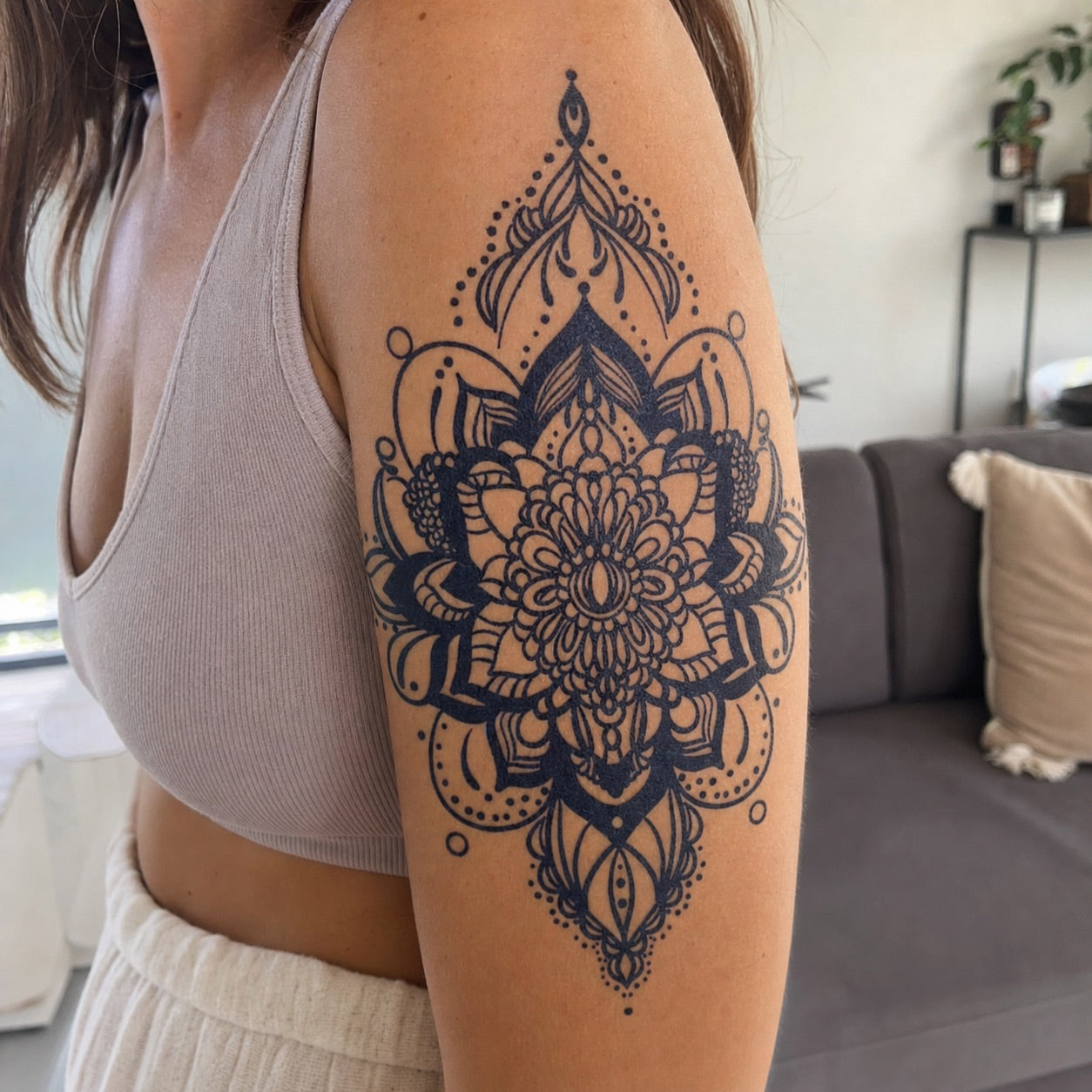
Stippled shading, gradients built point by point. Dotwork is the king of lotus styles because the technique itself feels meditative — the patience is visible in the skin. The diamond mandala lotus shows the effect: depth without a single solid fill.
Mandala lotus
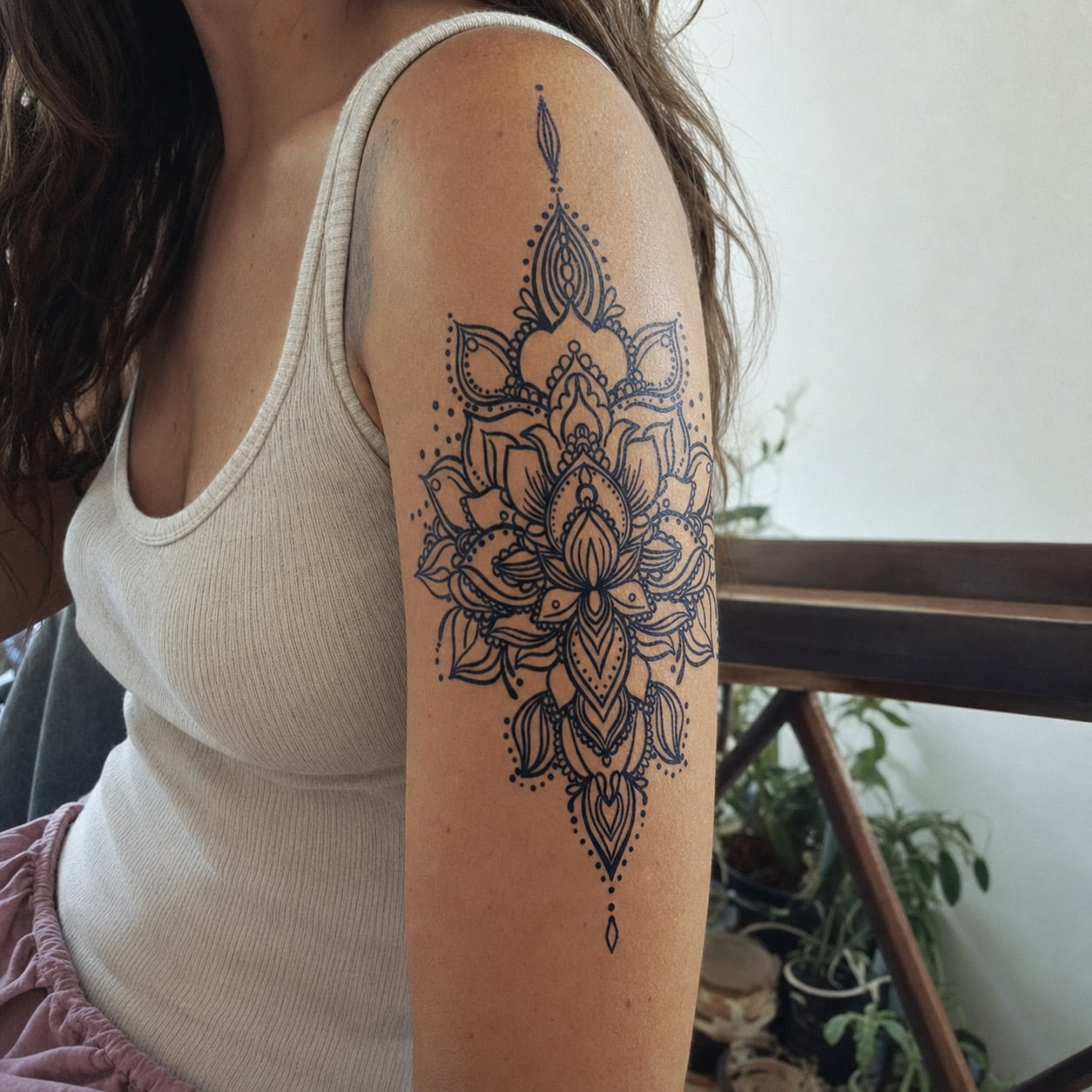
Geometry meets petals: the mandala adds the idea of balance and a center to the lotus's growth story. Together they say something precise — transformation with an axis. The vertical ornamental lotus is the format this style was born for: stacked elements running down the spine.
Unalome lotus
The spiritual trend of the decade: a winding line that straightens as it rises, crowned by the flower. The unalome charts the path to clarity — the spirals are the wandering, the straight line is the arriving, the lotus is what blooms at the end. It's a Buddhist symbol, so the respect rules above apply doubly: upper body, worn with intention. Slim and vertical, it fits forearms, the sternum and the back of the neck beautifully. And since every path is different, this is the design people personalize most: draw your own spirals and upload them as a custom jagua tattoo.
Fine line lotus
A few clean strokes, petals barely closed around each other. The fine line lotus whispers what the mandala declares, and it's the version that works below 5 cm — wrist, ankle, behind the ear. Minimal doesn't mean less meaningful; it means the meaning stays yours.
Lotus with flames
The intense reading: growth as trial by fire, the bloom and the burn in one image. A newer hybrid that borrows from blackwork's drama — the lotus and flame in blackwork is exactly this sentence, for people whose mud was more of a furnace.
Colors, briefly
In the traditions, color carries meaning: white for purity, pink for the Buddha's own flower, blue for wisdom, red for the heart. True, and secondary — across every style above, the lotus does its finest work in black ink, where the layered petals read clearly for decades.
And the honest testing note: jagua develops blue-black, always. A jagua trial shows you the design, the size and the placement; if you dream of a pink lotus, that's a conversation for your artist afterwards.
Where to place a lotus tattoo
| Placement | Best styles | Recommended size |
|---|---|---|
| Spine | Vertical mandala, stacked ornamental — the lotus's royal spot | 10–30 cm |
| Sternum | Symmetrical mandala, unalome | 6–12 cm |
| Forearm | Unalome lotus, dotwork | 6–14 cm |
| Back of the neck | Small mandala, fine line | 3–6 cm |
| Wrist / ankle | Fine line, minimal bud | 2–5 cm |
| Shoulder blade | Larger mandala, lotus with flames | 8–16 cm |
Remember the respect rule from above: for the spiritually loaded versions, upper body. And remember the practical one: symmetry is unforgiving, which makes the lotus the single best argument for testing placement before needles are involved.
Lotus tattoos that aged badly (the honest list)
The Wanderlust-era lotus. Mid-2010s, paired with arrows, mountains and the word "wanderlust" in cursive. The flower survived; the collage didn't. A lotus alone says more than a lotus in a mood board.
The lower-back lotus. Beyond the dated placement, it's the exact spot the respect rule warns about. The spine — higher up — does everything this placement tried to do, better.
The lotus with "namaste" underneath. The flower didn't need the caption. Symbols that require subtitles age like subtitles.
The micro-lotus on the finger. Layered petals in a placement that blurs detail faster than any other. In jagua it's two fun weeks; in permanent ink the petals merge into a smudge within a couple of years.
Try your lotus before it's forever
Symmetry, size, placement, and a meaning you'll carry: the lotus asks for more decisions than most motifs. Our temporary lotus tattoos use natural jagua ink: it develops blue-black in the top layers of the skin, holds every dot of a dotwork gradient, lasts 1 to 2 weeks and fades on its own. Waterproof, painless, applied at home.
Have your own design — an unalome with your own path in it, a mandala with a date at the center? Upload it as a custom jagua tattoo (minimum 3 pieces, handy for testing the spine against the sternum). And if the rose is calling you instead, her chapter is written too — with the same honesty.
From the mud, onto your skin.
Dotwork, mandalas and unalome designs in natural jagua ink. Blue-black like fresh work, 1–2 weeks on skin, applied at home.
Waterproof once developed · fades on its own · vegan
Lotus tattoo questions, answered
What is the meaning of a lotus tattoo?
Growth through hardship: the lotus rises clean out of muddy water, which made it a symbol of rebirth, resilience and spiritual awakening across Buddhist, Hindu and Egyptian traditions. Most people choose it to mark a recovery, an ending survived, or a hard-won new chapter.
Is a lotus tattoo good or bad?
The lotus is not a closed or forbidden symbol — wearing it as a sign of growth is fine. Two respect rules keep it right: place spiritual versions on the upper body (the lower body is considered less sacred in much of Asia), and don't combine it with religious imagery you don't understand, like a Buddha figure used as decoration.
What does the lotus tattoo mean in Thailand?
In Thai Buddhist culture the lotus is an offering flower and a symbol of enlightenment. The flower itself is worn without issue; sensitivity concerns sacred imagery like Buddha figures, and sacred symbols placed on the lower body. Keep a lotus on the upper body and you're honoring the symbol, not offending it.
What does the lotus symbolize spiritually?
Purity that isn't naive: the bloom comes up unstained precisely because it grew through the mud. In Buddhism it stands for the mind rising above attachment; the unalome-and-lotus combination charts the whole path — wandering spirals, a straightening line, and the flower at the point of clarity.
Where is the best place for a lotus tattoo?
The spine is the lotus's royal placement — vertical mandala formats were practically made for it. The sternum suits symmetrical designs, the forearm carries unalome versions well, and fine line buds work at the wrist. For spiritual designs, stay upper body.
Can I test a lotus tattoo before getting it permanently?
Yes, and the lotus is the best case for it: symmetry and placement are unforgiving. Jagua ink develops blue-black in the skin, holds dotwork detail, lasts 1–2 weeks and is waterproof — you wear the exact design at the exact spot, then decide with evidence.