

Tattoo trends move fast. What was all over Instagram two years ago can feel dated by the time you actually get an appointment, and popular artists are often booked months ahead, with even a small piece starting at a studio minimum of £80 to £100 or more.
That's where temporary tattoos come in. Not the shiny transfers from a party bag: jagua ink that colours your skin a realistic blue-black and lasts one to two weeks, then fades on its own. No needles. No deposit.
Here are the 10 tattoo trends defining 2026, what's fading, and how to try each style before committing to permanent ink.
1. Fine line (still number one)
Fine-line tattoos have been the dominant style for years, and 2026 isn't changing that. Ultra-thin single-needle work, delicate florals, tiny script and angel numbers are still what studios get asked for most.

What's changing is placement. People are getting strategic about how tiny designs work with their anatomy: a micro butterfly on the collarbone that moves when you breathe, a single-line flower following the curve of the inner forearm, a word behind the ear that only shows with your hair up. Fine line is also notoriously tricky to get right permanently, as very thin lines can blur over the years, so trying the placement and scale first makes real sense. Our minimalist collection is full of designs made for exactly this.
2. Cybersigilism (the most 2026 style there is)
Sharp, thin, slightly sci-fi linework that looks like a cross between a circuit board, a thorny vine and a magic sigil. It came out of club and fashion culture and spread through Instagram and TikTok, and UK suppliers now list it among the styles of the year. The lines are designed to flow with the muscles, so placements like the spine, the collarbone, the back of the arm and the hip work best.
Good news for jagua: cybersigilism is all about thin, crisp black lines with no shading, which is exactly what jagua does well. It's also a style people often want to try before committing, because it's very much of its moment. Browse our line tattoos and abstract designs for the closest looks, or send us your own sigil as a custom jagua tattoo.
3. Microrealism (tiny, detailed, and honest about its limits)
Microrealism packs a lot of detail into a very small space: a pet portrait the size of a stamp, a detailed eye, a classical statue, a butterfly with every vein of its wings. It's one of the most talked-about trends of the year, especially for small pieces on the forearm and wrist.

Two honest points. First, in permanent ink, very small detailed pieces can blur within a few years as the ink spreads, which is why many artists suggest going slightly bigger than you'd planned. Second, jagua gives one even blue-black tone, so it can't reproduce soft grey shading: detailed line work, yes; photographic gradients, no. A temporary version is still useful for the most important question with microrealism, which is size. Try the design at two scales and see which one actually reads on your skin.
4. Neo-traditional (the style UK artists cite most)
Neo-traditional takes the bold outlines of old-school tattooing and adds more illustrative depth: richer detail, decorative frames, flowers, animals and portraits drawn with real weight. It sits at the top of several UK rankings this year, and it has deep roots here. Britain's tattoo history runs through sailors' swallows and anchors and London tattooists such as George Burchett, one of the best-known names of the early 20th century.

Bold lines are also the style that ages best: they stay readable for decades where very fine detail can blur. In permanent ink, neo-traditional is usually done in colour, but the strong linework translates well into jagua's single blue-black tone. The 2026 twist is scale: a classic dagger on a finger, a small swallow behind the ear. Try the classics with our old school, dagger, snake and anchor designs.
5. Y2K and nostalgia (bows, cherries and the lower back)
The nostalgia cycle runs from the 1970s to the early 2000s this year. Think bows, cherries, butterflies, stars, barbed wire redrawn in fine line, tribal patterns with a modern twist, and even the return of the lower-back placement, done with far more care than in 2003.

Gen Z likes it because it connects them to an era they grew up hearing about; millennials enjoy it as a callback to their teenage years, with better taste this time. Butterflies, cherries, stars and hearts lead the way. Nostalgia is also the trend most likely to feel dated again, which makes it a natural one to wear for two weeks rather than for life.
6. Patchwork, but curated
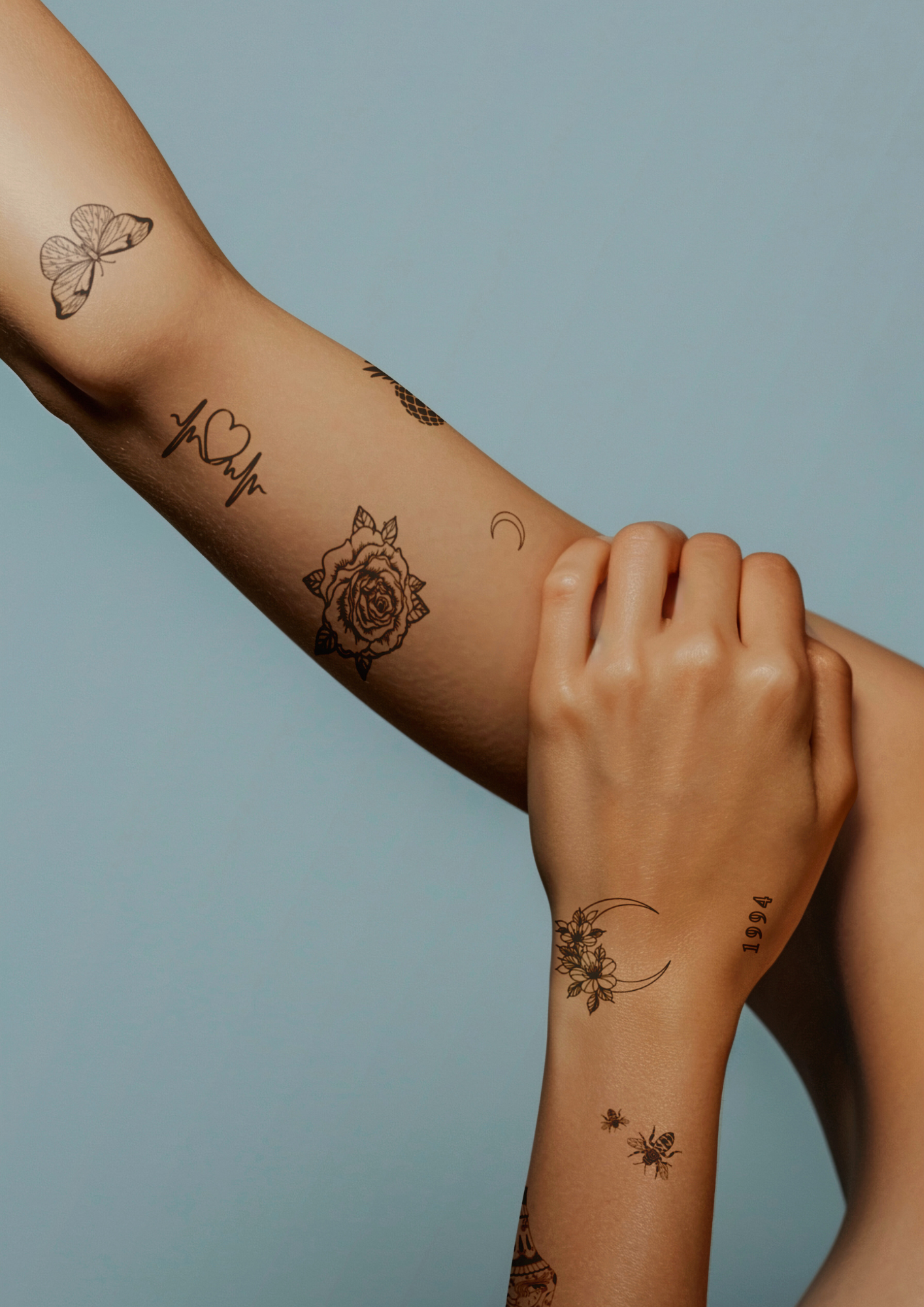
For a few years the patchwork look meant collecting small, unrelated tattoos, a smiley here and a coffee cup there. In 2026 it's growing up. People still build their collection piece by piece, but they're choosing pieces that belong together: a shared theme, a consistent line weight, a single colour. The result reads as one collage rather than a scrapbook.

Jagua actually helps here: every design comes out in the same blue-black, so a patchwork built from temporary tattoos looks coherent by default. It's also the easiest trend to plan by trial and error. Try a few pieces in different spots, see what works together, and swap what doesn't. Doodle-style pieces, which look like they were drawn in the margin of an exercise book, are a popular way into it.

Patchwork also works across people: the same tiny crescent moon on two best mates, or one smiley face for a whole hen do.

Start with small tattoos, sketch designs and the matching collection.
7. Birth flower bouquets
Birth flowers are taking a more emotional turn: rather than just their own month's flower, people are combining the birth flowers of their children, their partner, a parent they've lost or their closest friends into a single bouquet.

The 12 birth flowers: carnation (January), violet (February), daffodil (March, and Wales's national flower), sweet pea (April), lily of the valley (May), rose (June), larkspur (July), gladiolus (August), aster (September), marigold (October), chrysanthemum (November), narcissus (December).
Most are done in botanical fine line, with visible veins on the petals and stems that curve naturally, closer to an illustration from an old herbarium than a cartoon flower.

This is a tattoo to live with before making it permanent: three flowers or four, forearm or calf, which size reads clearly. Want your own family combination exactly? We print your artwork as a custom jagua tattoo, from £35 for 3. Or browse the floral collection.
8. Astrology and celestial tattoos
Astrology tattoos are getting more personal. Your sun sign is only the start: people now ink their full birth chart, the constellation overhead on the night you were born, or the moon phase from a date that matters. Moon phase rows, star sign glyphs, constellation maps, sun and moon pairings and planet symbols lead the way. Our star sign tattoo guide has ideas for all 12 signs.

Placement tends to be intimate. The inner wrist is the favourite, because you see it every day, followed by the space between the collarbones, the hollow behind the ear and, for anyone wanting a full sequence from new moon to full moon, a vertical line along the spine.
9. Mandalas and sacred geometry
Mandalas were the tattoo of 2018, and they didn't fade out, but the execution changed. They're now either ultra-minimal, with clean lines and lots of negative space, or oversized: a full shoulder cap, a sternum piece that spreads to the ribs, a back panel. Sacred geometry, from the flower of life to Fibonacci spirals, runs alongside for people who like the meditative feel with a more mathematical look.

These are among the most expensive designs to get permanently (long sessions that can run to several hundred pounds) and among the hardest to fix if the symmetry is off, so testing first is sensible risk management.
10. Fluid lines and ocean designs
Flowing, abstract linework that follows the body's curves, lines wrapping around the shoulder, waves along the arm, ribbons down the spine, keeps growing, often with an ocean theme: Japanese-style waves, jellyfish, koi.

These designs are made to be seen in motion: they open up when you raise your arm and shift when you walk. Curved areas (calf, forearm, thigh, the whole back) suit them best.

Have a look at our ocean designs and wave tattoos.
What's fading in 2026
Some designs that were everywhere a few years ago are clearly losing ground:
- The infinity symbol: the defining tattoo of the early 2010s, now one of the most dated.
- 1990s tribal armbands: tribal is coming back in modern, more considered forms, but the classic band isn't.
- Generic feathers and dreamcatchers: replaced by designs with a more personal story.
- White-ink-only tattoos: they tend to fade unevenly and can look like scarring over time.
The common thread: generic designs are giving way to personal ones. Which is also the best argument for testing first, because two weeks with a design tells you more than any amount of scrolling.
Colour is back. Here's where jagua fits
After years of black and grey, UK studios report a strong return of bright colour, from neo-traditional palettes to manga and streetwear influences. To be clear about what we do: jagua gives one tone, a deep blue-black, so it can't show you how a colour piece will look. What it can show you is the bit that matters most before any session, colour or not: the outline, the size and the placement. Many people test the linework in jagua, then add colour at the studio.

Two weeks, not forever.
Over 500 designs in jagua ink: blue-black, one to two weeks on your skin, then gone. Fine line, old school, celestial and more.
Free UK delivery from £39 · No customs charges
The best temporary tattoos to try in 2026
- Testing a real tattoo idea: a custom jagua tattoo of your own design. Upload your artwork, wear it for two weeks, then decide.
- Fine line: the minimalist collection.
- Old school and neo-traditional linework: old school designs.
- Star signs: star sign tattoos.
- Drawing your own: jagua gel, £14 for a 10 ml tube.
- Festival season: festival tattoos, waterproof once developed, so they'll survive a muddy Glastonbury.
Why jagua is the best way to try a trend
Trends are exciting now, but "now" has a shelf life: the infinity symbol of 2012, the dreamcatcher of 2014, the lavender sprig of 2015 were all genuine trends, and they're all permanent on somebody. Jagua comes from the fruit of Genipa americana, native to the Amazon. It develops blue-black in the top layer of the skin over 24 to 48 hours and fades naturally over one to two weeks as the skin renews.
- Transfer tattoos: they last a few days, look shiny and peel at the edges. Jagua colours the skin itself.
- Henna: henna stains orange to reddish-brown and lasts 5 to 14 days. Jagua turns blue-black, much closer to tattoo ink.
- Permanent ink: a small permanent tattoo costs from around £80 and lasts forever. A jagua design costs from around £5, takes about two minutes to apply and gives you two weeks to decide.
More on how semi-permanent tattoos work and on aftercare.
How to choose the right trend for you
First tattoo: fine line or minimalist. Small. Wrist or ankle.
Something personal: birth flower bouquets, a birth chart, or matching designs with someone you love.
Something of its moment: cybersigilism or Y2K. Perfect to wear for two weeks, riskier to wear for life.
Something that ages well: bold lines. Always.
Testing before going permanent: the exact design, in the exact place, at the exact size. If you still love it on day 14, book the appointment.
Tattoo trends 2026: your questions
What is the newest tattoo trend in 2026?
Cybersigilism is the most distinctly 2026 style: sharp, thin, sci-fi linework that flows with the body. Microrealism and a more curated version of patchwork are also rising, while fine line remains the most requested overall.
Are tattoos going out of style in 2026?
No. What's going out of style are generic designs: infinity symbols, 1990s tribal bands, feathers. The shift is towards personal designs with a story behind them, and towards testing ideas before committing.
Which tattoo styles age well?
Bold linework ages best: traditional and neo-traditional designs stay readable for decades. Very fine lines and tiny detailed pieces can blur as the ink spreads over the years, so artists often suggest going slightly bigger than planned.
How long do jagua temporary tattoos last?
One to two weeks, depending on placement and skin type. The forearm, upper arm and back hold the colour longest; hands and fingers fade faster. The colour develops over 24 to 48 hours. Keep it away from water and rubbing for the first 8 hours.
Can I use a temporary tattoo to test a design before getting permanent ink?
That's one of the best uses. Apply it in the exact spot you're considering and live with it for a week or two. You'll learn how it looks with your clothes and if the scale is right. Above all, you'll find out if you still like it once the novelty wears off, which is the real test.
Do temporary tattoos work on all skin tones?
Jagua works on all skin tones. The contrast is strongest on lighter skin; on deeper skin tones the tattoo shows more subtly, and bold designs with solid lines look best.
What's the difference between jagua and henna?
Mainly the colour. Henna stains orange to reddish-brown; jagua turns blue-black. Both are plant-based. Avoid "black henna": it isn't real henna and contains PPD, which can cause severe reactions. More in our guide to black henna.
Is jagua safe for my skin?
Jagua is well tolerated by most people, and our tattoos are PPD-free. Allergic reactions are rare but possible: in July 2025 the British Journal of Dermatology described a severe case after a "jagua henna" tattoo, a jagua and henna mix. With sensitive skin or a tropical fruit allergy (mango, papaya, kiwi), do a patch test 48 hours before. Not suitable for children under 3.