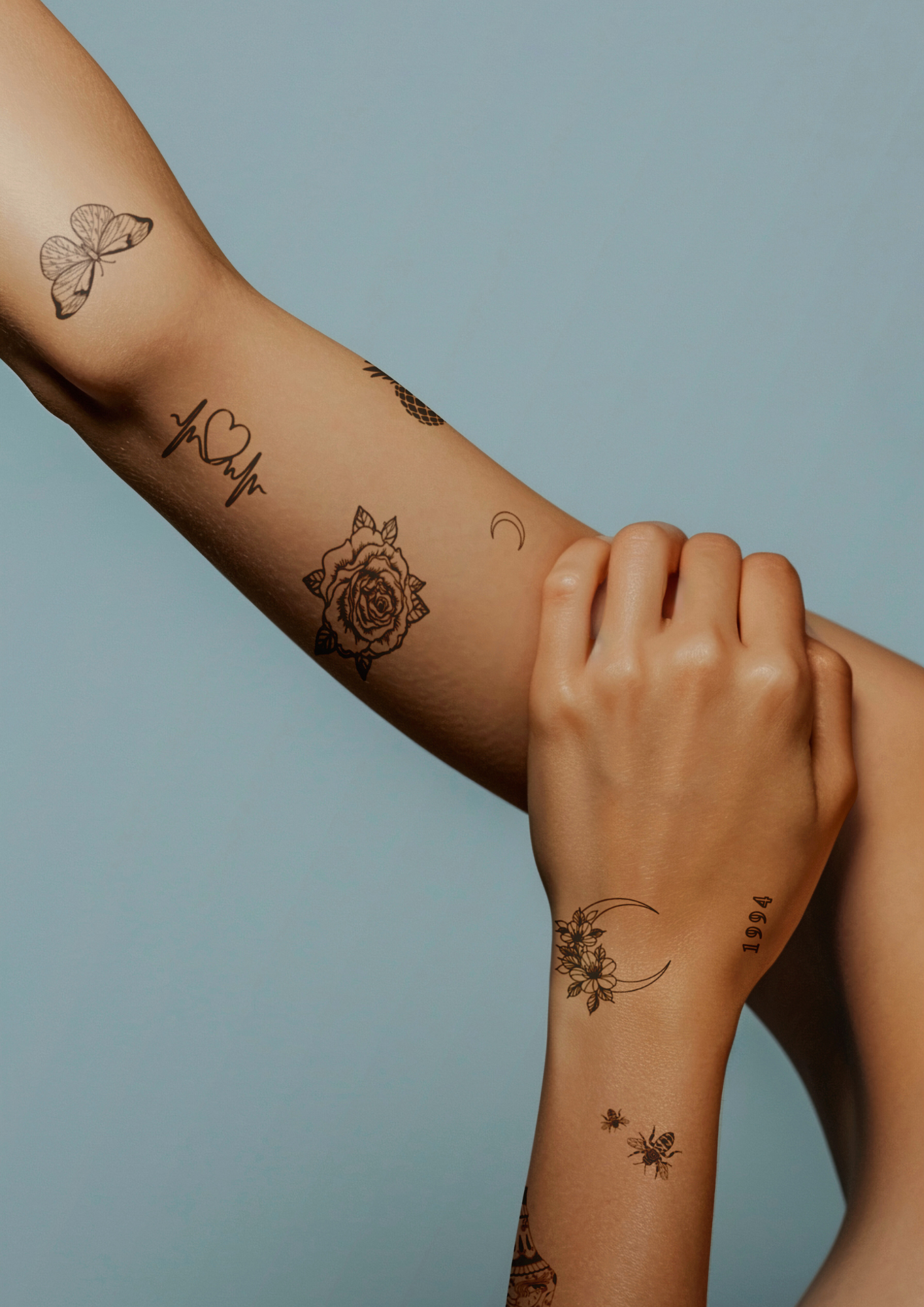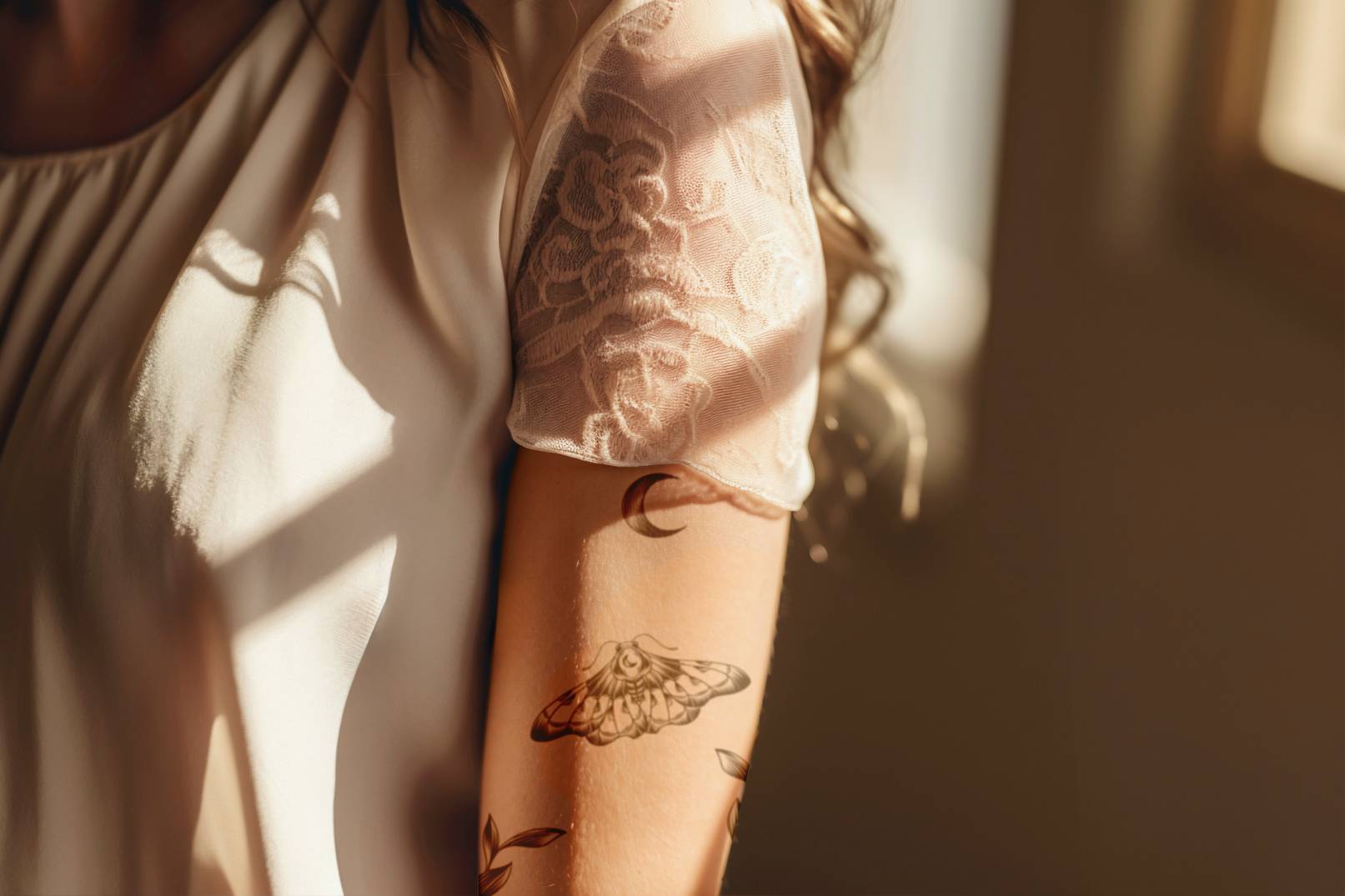


Tattoo trends move fast. What was everywhere on Instagram two years ago can feel dated by the time you actually book an appointment. And that's assuming you can get an appointment — popular artists are booked 3 to 6 months out, and a single session starts around $150 for something small.
That's where temporary tattoos come in. Not the shiny sticker kind from a vending machine — we're talking jagua ink that stains your skin a realistic blue-black and lasts 1 to 2 weeks. It looks like a real tattoo, wears like a real tattoo, and fades on its own. No needles, no regrets, no $300 deposit.
Here are the 10 tattoo trends defining 2026 — and how to try every single one before committing to permanent ink.
1. Fine-line everything (still #1, and it's not close)
Status Confirmed — still everywhere in July.
Fine-line tattoos have been the dominant style for years now, and 2026 isn't changing that. Ultra-thin single-needle work — delicate florals, tiny script, soft ornamental accents — continues to be the most requested style at tattoo shops across the country.

What's evolving is how people think about placement. It's not just "small tattoo on the wrist" anymore. Clients are getting strategic about how tiny designs interact with their anatomy: a micro butterfly on the collarbone that moves when you breathe, a single-line flower that follows the curve of the inner forearm, a word tucked behind the ear that only shows with the right hairstyle.
Celebrities like Kaia Gerber and Hailey Bieber have made micro-tattoos feel like jewelry — small, intentional, and additive rather than statement-making. The appeal for temporary tattoos here is obvious: fine-line designs are notoriously tricky to get right permanently (they can blur or fade unevenly), so testing placement and scale with jagua first is genuinely practical.
Try the look: our minimalist collection has over 100 fine-line designs built for exactly this style.
2. Sticker-style patchwork (the Gen Z signature)
Status Confirmed — still everywhere in July.
This is probably the single most defining tattoo trend of 2026, and it's being driven almost entirely by Gen Z. Instead of planning cohesive sleeves or thematic pieces, younger clients are collecting small, unrelated tattoos — a smiley face here, a coffee cup there, a random doodle on the ankle — building a "curated sketchbook" on their body over time.

The look is deliberately casual. Each piece is designed to stand alone, like a sticker on a laptop or a pin on a tote bag. No grand narrative, no deep meaning required. Some pieces are funny, some are sentimental, some are purely aesthetic. The collection itself becomes the statement.
This is the trend that temporary tattoos were basically invented for. You can test different "stickers" in different spots, see how they work together, and swap them out every couple of weeks. Build your patchwork gradually instead of committing to 15 pieces at once.
Start here: browse small tattoos, cute tattoos, and smiley face tattoos — the building blocks of patchwork style.
3. Birth flower bouquets (the most personal trend of the year)
Status Confirmed — still everywhere in July.
Birth flower tattoos aren't new, but 2026 takes them somewhere more emotional. Instead of just getting your own birth month flower, people are creating family bouquets — combining the birth flowers of their kids, their partner, a parent they lost, or their closest friends into a single composition.

The 12 birth flowers: carnation (January), violet (February), daffodil (March), sweet pea (April), lily of the valley (May), rose (June), larkspur (July), gladiolus (August), aster (September), marigold (October), chrysanthemum (November), narcissus (December).
Most birth flower tattoos are done in fine-line botanical style — detailed enough to identify each flower, delicate enough to feel elegant. The inner forearm is the most popular placement (visible, easy to show people, flat surface for detail), followed by the ribs and along the spine for vertical bouquets.
This is a tattoo you want to live with before making permanent. A temporary version lets you check whether three flowers look better than four, whether the forearm or the calf feels more "you," and whether the design reads clearly at the size you're imagining.
Explore: our floral collection includes over 50 botanical designs, from single stems to full bouquets.
4. Y2K nostalgia (chrome butterflies, Lisa Frank energy, and everything early 2000s)
Status Peaking now — the moment to try it.
The nostalgia cycle has officially reached the early 2000s, and it's showing up on skin. Think chrome-effect butterflies, metallic stars, barbed wire reimagined with fine-line technique, tribal patterns done with a modern twist, and designs that feel like they belong on a Lisa Frank folder or a Bratz doll accessory pack.

This trend spans generations. Gen Z is drawn to it because it connects them to an era they grew up hearing about. Millennials embrace it as a nostalgic callback to their teenage years — but with better taste and better execution. The designs aren't carbon copies of 2003 tattoos; they're updated with cleaner lines, subtler placement, and more intentional composition.
Butterfly tattoos are leading this wave. The butterfly has always been one of the most popular tattoo motifs, but in 2026 it's getting a Y2K filter: iridescent, chrome-inspired, or done in a hyper-minimalist single-line style that feels both retro and modern.
Other Y2K-coded designs trending right now: stars, hearts, flames, cherries, and playful text in bubbly or retro fonts.
5. Matching and friendship tattoos (low-pressure, high-meaning)
Status Confirmed — still everywhere in July.
Matching tattoos are having a moment — but with a very different energy than the couple tattoos of the past. In 2026, matching ink is about friendship, sisterhood, and shared experiences. Two best friends getting the same tiny crescent moon. A bachelorette crew all wearing the same smiley face for the weekend. Siblings getting their birth flowers intertwined.

The stakes feel lower because the designs are small and the meaning is about the moment, not the relationship. Nobody's tattooing a partner's name on their ring finger anymore. They're getting a tiny lightning bolt with their college roommate because it makes them laugh.
Temporary tattoos are genuinely perfect for this. You can order a set, show up to the beach trip or the bachelorette or the reunion with matching ink that looks real, and nobody has to deal with the "what if we stop being friends" conversation. Our matching tattoo collection is designed for exactly this — sets of two with complementary designs.
6. Botanicals gone hyperrealistic
Status Holding steady.
Floral tattoos aren't going anywhere — they've been a top-3 tattoo category for years. But in 2026, the aesthetic is shifting from simple line drawings to something closer to a botanical illustration. Think visible veins on petals, natural shadow and depth, stems that curve organically rather than sitting flat.

The flowers getting the most attention right now: roses (always), peonies (luxury, femininity), lotus (rebirth, spiritual meaning), wildflower bunches (cottagecore energy), and sunflowers (warmth, optimism).
What's driving this evolution is partly Instagram — hyperrealistic botanicals photograph beautifully — and partly a broader "return to nature" aesthetic that's been building for a few years. These tattoos feel organic, timeless, and deeply personal, especially when tied to meaning (a grandmother's garden, a wedding bouquet, a favorite hiking trail).
Jagua ink works especially well for botanical designs. The blue-black tone naturally mimics the fine shading and gradients that make these tattoos look real, without the shiny film of a sticker transfer.
7. Astrology and celestial tattoos (your chart, on your skin)
Status Confirmed — still everywhere in July.
Astrology tattoos aren't new, but the way people are approaching them in 2026 is more personal and more specific. It's not just your sun sign symbol anymore — it's your full birth chart mapped out, the exact constellation visible on the night you were born, or the moon phase from a specific date that matters to you.
The most popular celestial designs right now: moon phase sequences (new moon to full moon in a line), zodiac sign glyphs, constellation maps, sun and moon pairings, and planetary symbols (Venus, Saturn, and Mars are the most requested).

Placement tends to be intimate: inner wrist (daily visibility), between the collarbones (heart-cosmos connection), behind the ear (subtle, personal), or along the spine (dramatic, usually for a full moon phase sequence).
Before you permanently ink your rising sign, try living with it for two weeks. A temporary version lets you check that the scale feels right, the placement works with your wardrobe, and you don't get tired of explaining what Sagittarius means to every person who asks.
Browse: our spiritual collection covers lunar symbols, astrological designs, chakras, and sacred geometry.
8. Doodle and sketch style (the anti-perfect tattoo)
Status Rising — bigger than we predicted.
This trend is a direct reaction to the hyper-polished fine-line aesthetic. Doodle-style tattoos look like they were drawn in a notebook during class — slightly imperfect lines, handwritten text, characters that feel spontaneous rather than planned. They're playful, emotional, and deeply personal.

Gen Z is driving this hard. As INKED by Dani founder Dani Egna told Teen Vogue, younger audiences are gravitating toward body art that feels low-pressure and personal. Doodle tattoos embody that perfectly — they look like inside jokes, personal symbols, or quick sketches that captured a feeling.
Popular doodle motifs: hand-drawn hearts, stick figures, wobbly stars, cartoon faces, handwritten words or dates, and simple line drawings of everyday objects (a coffee cup, headphones, a slice of pizza). The "imperfection" is the point — it makes the tattoo feel human.
Check out our sketch tattoo collection for designs that capture this raw, authentic energy.
9. American Traditional revival (bold, clean, and aging like a classic)
Status Holding steady.
American Traditional never actually left, but 2026 is bringing a genuine re-appreciation. Younger clients are discovering that bold outlines, limited color palettes, and classic motifs — eagles, roses, daggers, snakes, skulls, anchors — do something that trendy fine-line pieces often can't: they age well.

In a world of hyper-detailed micro-realism that can blur within a few years, American Traditional designs stay clean and legible for decades. That durability is becoming a selling point, not a limitation. Bold lines photograph cleanly, read from a distance, and carry a cultural weight that connects you to over a century of tattoo history.
The 2026 twist: younger clients are mixing Traditional motifs with modern placement and scale. A classic dagger on the finger instead of the forearm. A tiny rose behind the ear instead of a full sleeve panel. The iconography stays the same; the context changes.
Try the classics: dagger tattoos, snake tattoos, skull tattoos, and eagle tattoos — all in our catalog.
10. Mandalas and sacred geometry (evolved, not outdated)
Status Holding steady.
Mandalas were the tattoo of 2018, and some people assumed they'd fade out. They didn't. What changed is the execution. In 2026, mandalas are either going ultra-minimalist (clean lines, lots of negative space, geometric simplicity) or going oversized (a full shoulder cap, a sternum piece that extends to the ribs, a back panel).

Sacred geometry — the flower of life, Metatron's cube, Fibonacci spirals — is running alongside the mandala trend, appealing to people who want the meditative quality of circular patterns but with a more mathematical, less spiritual framing.
These designs are among the most expensive to get permanently (complex geometry means long sessions — $400 to $800+ for a detailed mandala), and they're among the hardest to fix if the symmetry is off. Testing with a temporary version isn't just convenient — it's practical risk management.
Explore: our geometric collection includes mandalas, sacred geometry, symmetrical patterns, and modern tribal-inspired designs.
The Best Temporary Tattoos to Try in 2026
Trends are great, but if you just want the shortlist — here's what actually delivers this year, based on what our US customers keep reordering:
- Best for testing a real tattoo idea: a custom jagua tattoo of your own design — upload your artwork, wear it for two weeks, then decide.
- Best fine-line florals: flower tattoos — the 2026 trend that photographs best.
- Best matching sets: couple & matching designs — low commitment, high cute factor.
- Best zodiac pieces: zodiac sign tattoos — the celestial trend isn't slowing down.
- Best for freehand creativity: jagua gel — draw your own, lasts just as long.
- Best for festival season: festival tattoos — waterproof once developed, Coachella-proof.
Everything above is plant-based jagua — semi-permanent, blue-black, and gone in about two weeks.
Why jagua is the best way to test-drive a trend
Here's the thing about trends: they're exciting right now, but "right now" has a shelf life. The lavender sprig that was everywhere in 2015? The infinity symbol from 2012? The dreamcatcher from 2014? All were genuine trends. All feel dated now. And they're all permanent on somebody's body.
Jagua temporary tattoos let you ride a trend without the risk. The ink comes from the Genipa americana fruit (native to the Amazon), stains your skin a realistic blue-black, and fades naturally over 1 to 2 weeks as your skin exfoliates. No shiny film, no peeling edges, no "that's obviously fake" moments.
How jagua compares to other options:
- vs. sticker/water-transfer tattoos: Those last 1 to 3 days, look shiny, wrinkle on contact, and peel at the edges. Jagua stains your actual skin — nothing to peel, nothing to catch on fabric.
- vs. henna: Henna turns orange-brown. Jagua turns blue-black. If you want something that looks like a real tattoo (not a bridal pattern), jagua is the only natural option.
- vs. permanent ink: A small permanent tattoo costs $150 to $300+, takes 2 to 4 weeks to heal, and lasts forever. A jagua temporary tattoo costs $8 to $15, takes 30 seconds to apply, and gives you 1 to 2 weeks to decide if you actually like it.
Vegan. PPD-free. Free US shipping on orders over $75.
Not sure how the ink behaves? Here's how semi permanent tattoos actually work — and once yours is on, this aftercare routine keeps it sharp for the full two weeks.
How to choose the right trend for you
If it's your first tattoo (temporary or permanent): Start with fine-line or minimalist. A small symbol on the wrist or ankle is low-commitment and universally flattering. If you're not sure what you want, this is the safest entry point.
If you want something personal: Birth flower bouquets, celestial birth charts, or matching designs with someone you love. These trends are about meaning, not just aesthetics.
If you want to have fun: Sticker-style patchwork, doodle tattoos, or Y2K nostalgia pieces. These are playful, low-pressure, and designed to make you smile — not to impress a tattoo purist.
If you want something timeless: American Traditional motifs or hyperrealistic botanicals. These styles have proven staying power across decades, not just trend cycles.
If you're testing before going permanent: Try the exact design, in the exact placement, at the exact scale you're considering. Live with it for two weeks. If you still love it on day 14, book the appointment. If you don't, you just saved yourself $300 and a laser removal consultation.
FAQ: tattoo trends and temporary tattoos
What are the most popular tattoo styles in 2026?
Fine-line and minimalist designs remain the #1 most requested style. Sticker-style patchwork is the fastest-growing trend, especially among Gen Z. Birth flower bouquets, celestial/astrology tattoos, and Y2K nostalgia designs are also surging. American Traditional is experiencing a genuine revival among younger clients.
How long do jagua temporary tattoos last?
7 to 14 days depending on placement and skin type. The forearm, upper arm, and back hold color longest. Hands and fingers fade faster due to friction and frequent washing. The color develops over 24 to 48 hours — it starts light and darkens to a realistic blue-black.
Can I use a temporary tattoo to test a design before getting permanent ink?
That's one of the best uses. Apply the temporary version in the exact placement you're considering, live with it for a week or two, and see how it feels in your daily life. You'll learn things you can't predict from a sketch on paper — how it looks with your wardrobe, whether the scale is right, and whether you still like it after the novelty wears off.
Do temporary tattoos work on all skin tones?
Jagua works on all skin types. Contrast is most visible on light to medium skin tones. On deeper skin tones, the tattoo still shows but with a subtler effect — bold designs with solid lines tend to look best.
What's the difference between jagua and henna?
Color. Henna turns orange to reddish-brown. Jagua turns blue-black — much closer to the look of real tattoo ink. Both are natural and plant-based. Jagua is extracted from the Genipa americana fruit (Amazon basin); henna comes from the Lawsonia inermis plant (South Asia, Middle East). Avoid "black henna" — that's not real henna, it contains PPD (a chemical that can cause severe allergic reactions).
Which trend works best as a temporary tattoo?
All of them, honestly. But sticker-style patchwork and matching/friendship tattoos are practically built for temporary ink — you can swap designs, try new combinations, and keep things fresh without any permanent commitment. Birth flower tattoos and celestial designs are also great candidates for testing before going permanent, since placement and scale matter so much for those styles.