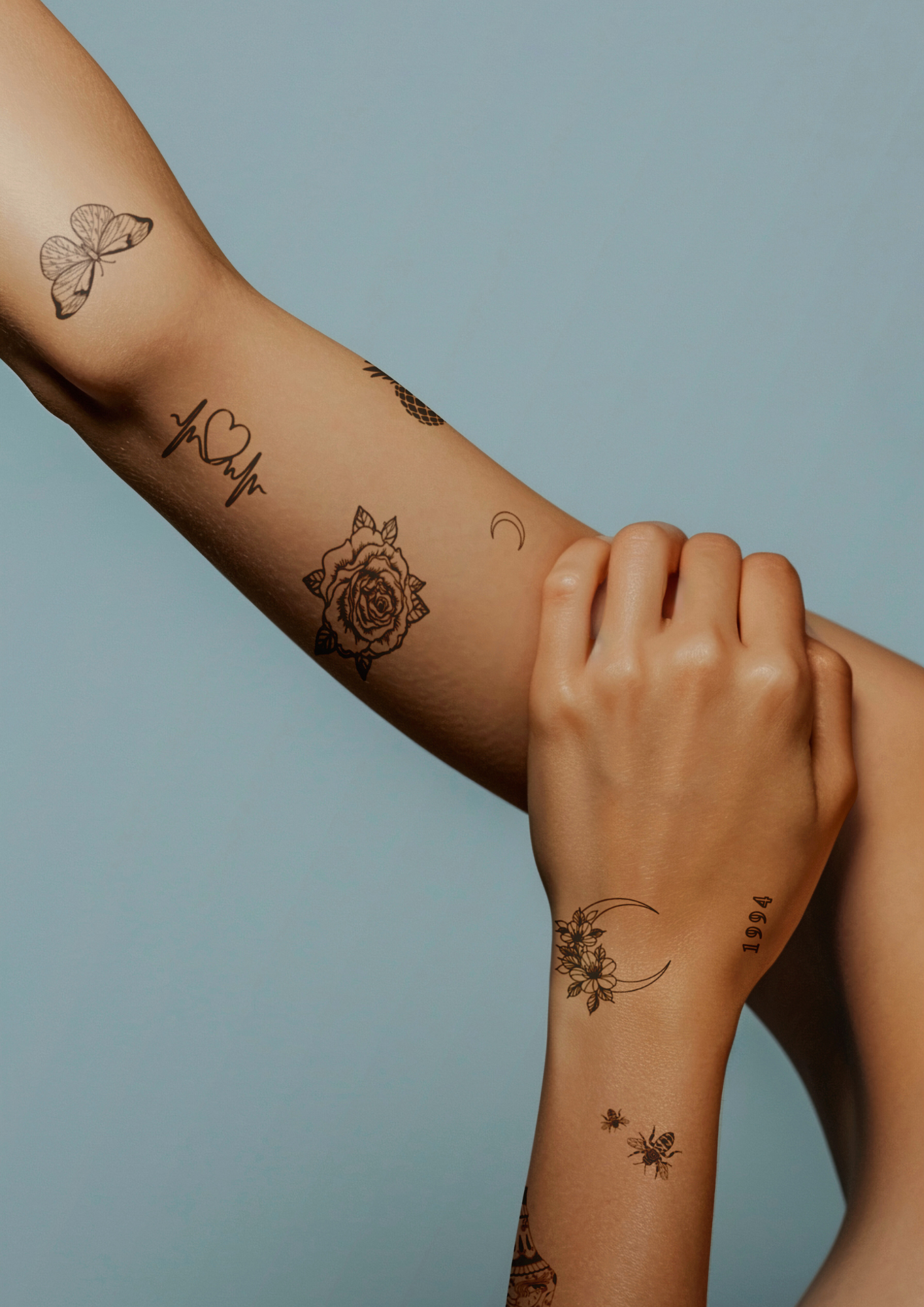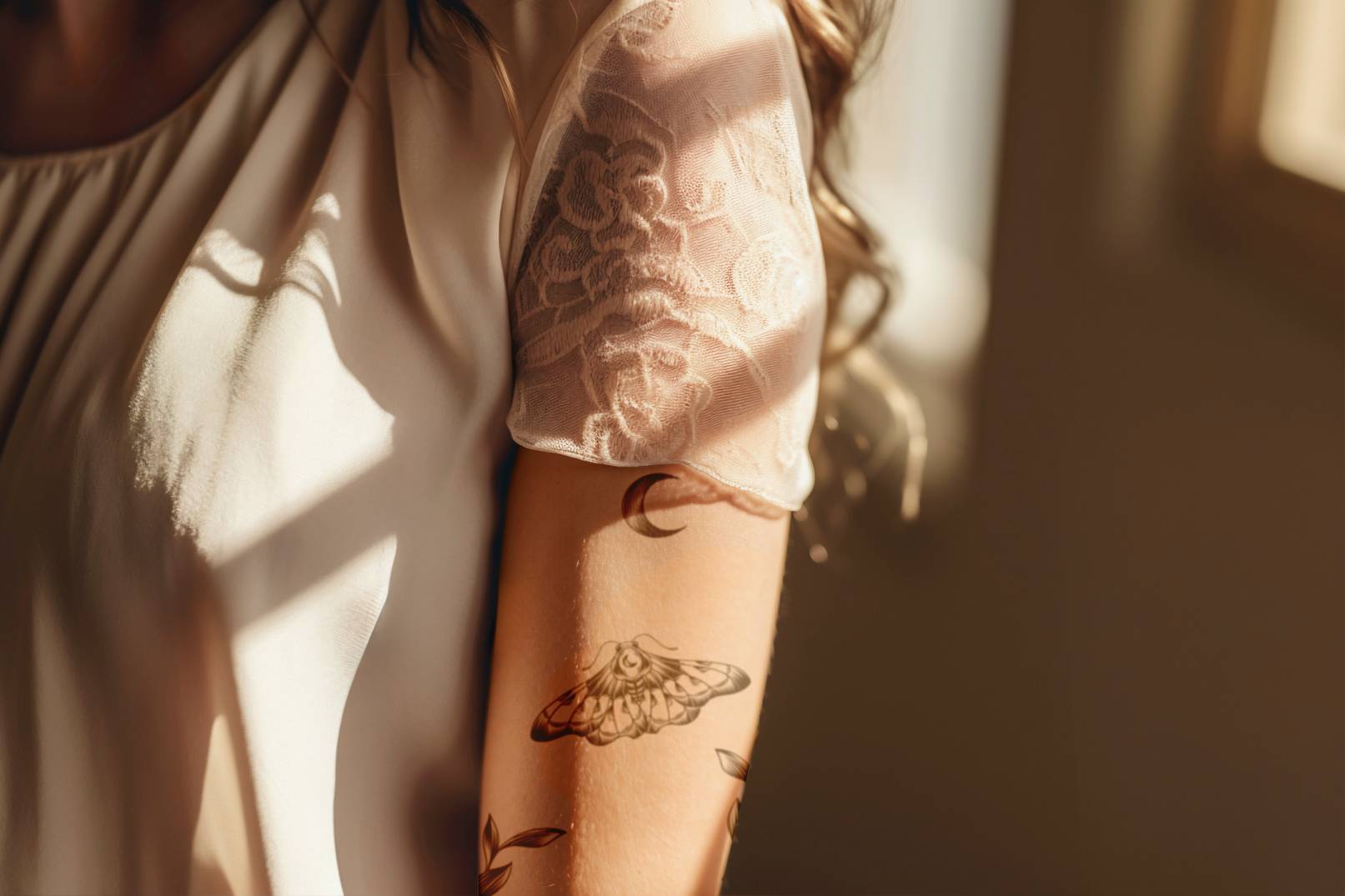


The butterfly is one of the most requested tattoo designs in the country, and somehow all that popularity hasn't worn its meaning thin. People rarely pick one at random. They pick it because the symbolism lands somewhere real: change after a hard stretch, freedom after feeling stuck, beauty that matters precisely because it doesn't last forever.
If you're here, it's probably for one of two reasons. Either you're thinking about a permanent butterfly and want to understand what it says before you book a studio. Or you want to wear one that looks like real ink, without the needle and without the "what if I hate it in three years" worry. This guide covers both.

What a butterfly tattoo actually means
The life cycle does most of the work. Inside its chrysalis, a caterpillar breaks down almost completely before rebuilding itself into something that can fly. That isn't a gentle metaphor. It's breakdown, then reconstruction, then wings.


People get butterfly tattoos when they recognize their own story in that process. A breakup that flattened them and led somewhere better. Getting sober. Getting through a diagnosis. Leaving a city, a job or a version of themselves they'd outgrown. The butterfly doesn't say "everything is fine." It says I went through it and I'm still here.
Transformation and growth
This is the core meaning, and the most common one. The metamorphosis metaphor works because it's honest: change isn't pretty halfway through. The caterpillar doesn't glide gracefully into its next form. It comes apart first. A butterfly tattoo acknowledges the messy middle, not just the wings at the end.
Freedom
Butterflies don't follow paths. They go where they like for as long as they live. People who have walked away from something (a relationship, a belief system, a hometown, a career) and chosen to live differently tend to gravitate toward this reading. Open wings, mid-flight poses and a trail of several butterflies in a row all play into it.
The soul and remembrance
In ancient Greek, the same word, psyche, meant both "soul" and "butterfly." In Mexico, monarchs arrive each fall around the Day of the Dead (Día de los Muertos) and are traditionally seen as the souls of loved ones coming back to visit. In Japanese folklore, a butterfly can stand for a wandering spirit. Choosing a butterfly as a memorial piece isn't purely aesthetic. It draws on thousands of years of cultural weight.
Mental health and the semicolon butterfly
This is one of the readings people search for most, and it has an American origin. Project Semicolon started in 2013 around one idea: a semicolon marks a sentence the author could have ended but chose to continue. Add butterfly wings and you get one of the most recognized mental health symbols in tattoo culture: my story isn't over, and I'm still becoming something new. It's often chosen by people living with or recovering from depression, anxiety or self-harm, and by the people who stood next to them. We go deeper into the symbol in our guide to semicolon tattoo meaning.
Monarchs and migration
The monarch has a meaning in the US that it doesn't really carry anywhere else. Every fall, millions of them fly from the northern states and Canada down to the mountains of central Mexico, a trip no single butterfly completes twice. That crossing turned the monarch into a symbol of migration and of families who made the same journey north, with wings to say that moving isn't a crime. For a lot of people with roots on both sides of the border, a monarch tattoo is a quiet statement about where they come from.
The butterfly in LGBTQ+ culture
There's no official LGBTQ+ butterfly, but the image comes up often, especially among trans and nonbinary people. The reason is the same metamorphosis: a body and an identity that change until they finally match. For some it marks a coming out, for others a transition, or simply the moment they stopped hiding. Like every other reading here, it only means that if you want it to.
Femininity, but not the fragile kind
Butterflies have been linked with femininity for decades, but the framing has shifted. In Aztec belief, the souls of warriors who fell in battle came back as butterflies. Seen that way, a butterfly isn't delicate at all: it's a creature that came out of taking its own body apart. And plenty of men wear them, from traditional Americana flash to blackwork moths. A butterfly tattoo isn't about being soft. It's about surviving something brutal and coming out transformed.
Colors and what they mean
A quick note first: jagua, the fruit our ink comes from, gives a single color, a deep blue-black. That happens to be the most timeless shade in tattooing. But if you're weighing a permanent butterfly, or you're simply curious about color symbolism, here's the shorthand:
| Color | Meaning | Often chosen for |
|---|---|---|
| Blue (morpho) | Calm, hope, spiritual connection | Memorial and spiritual pieces |
| Black | Strength, transformation, elegance | Fine-line and minimalist styles |
| Monarch (orange and black) | Endurance, heritage, migration, the Day of the Dead | Family memorials, cultural tributes |
| Red | Passion, courage, fierce independence | Statement pieces, bold placements |
| White | New beginnings, purity | Understated, low-key pieces |
With a jagua temporary tattoo, you get that blue-black. It reads like classic tattoo ink and works with every style and placement in this guide.
Styles worth knowing
Fine-line

Thin, precise lines, minimal shading, a lot of elegance. Fine-line butterflies look great behind the ear, on the wrist or along the collarbone. As a temporary: this is where jagua shines, because crisp, fine linework prints cleanly on the transfer. Browse our fine-line tattoos.
Micro and minimalist
Smaller still: a butterfly under an inch that fits on a finger, the side of the wrist or just behind the earlobe. One clean silhouette, no interior detail, just shape and suggestion. Ideal for a first tattoo or for stacking with other minimalist designs. As a temporary: works beautifully. Small and simple means a sharp result.
Realistic and 3D

Detailed wing veins, natural gradients and shadow work that make the butterfly look three-dimensional. It needs space, think 3 inches and up on the forearm, shoulder, upper back or thigh. As a temporary: full photographic detail is harder to reproduce, but realistic designs get you surprisingly close, and they're a smart way to test size and placement before you commit to a long studio session.
Watercolor
Soft washes of color bleeding past the outlines. Beautiful, but here's what a lot of guides leave out: in permanent ink, watercolor tattoos can age unpredictably, with colors spreading and blurring over the years. As a temporary: this one doesn't translate, because jagua only gives blue-black. If you love the watercolor look, a temporary butterfly can still help you settle the shape, size and placement before you hand the color work to an artist.
Geometric

Clean lines, symmetry, negative space. The butterfly built from structure: triangles, hexagons, intersecting lines. It pairs well with geometric and mandala designs. As a temporary: geometric work prints well. Sharp lines, no gradients, no ambiguity.
Butterfly and flowers

A butterfly perched on or surrounded by roses, cherry blossoms or wildflowers. It layers the symbolism: nature, beauty, things that don't last forever. It's one of the most-loved combinations out there. Already sketched your own version? You can turn your drawing into a custom jagua tattoo.
Best placements (and what each one says)
Behind the ear

Small and subtle, it only shows when you tuck your hair back. It says: I know something you don't. Fine-line and micro styles under an inch work best here. Hair and earbuds rub against this spot, so a temporary may fade a little sooner than on the arm.
Wrist

The classic test spot. Easy to show, easy to hide. A single small butterfly on the inner wrist is a very common first tattoo, permanent or temporary. If you're unsure where to start, start here.
Collarbone
One of the most flattering spots for a butterfly. A single design or a mirrored pair frames the neckline beautifully with off-the-shoulder tops, sundresses and V-necks. Little friction here, so jagua holds well.
Forearm

The most visible placement. If you're after the "wait, is that real?" reaction, this is it. The forearm suits compact designs and larger pieces alike, and it's a good place to test a permanent idea or wear something for a wedding, a festival or a birthday.
Shoulder and upper back

Where butterflies have room to spread their wings. Open-wing designs across the shoulder or between the shoulder blades make a striking statement, especially with a tank top or a low back. It's also one of the areas where jagua lasts longest, thanks to low friction.
Ankle

Playful and low-key, it works with everything from flip-flops to boots, and small butterflies on the inner or outer ankle never really go out of style, although shoes rub here all day, so a temporary one may fade a little sooner than it would on your arm.
Spine
A vertical trail of butterflies down the spine is one of the most dramatic placements there is: elegant, symmetrical and very photogenic. If you're considering it permanently, wearing it as a temporary first tells you whether you love the look from one day to the next.
Are butterfly tattoos basic?
Let's get into this, because it comes up constantly, usually from people who've never looked at a butterfly tattoo up close.
Butterflies are among the most popular tattoo designs in the world. Does that make them "basic"? Only if popularity automatically means a lack of depth. Nobody calls star tattoos or moon tattoos basic, and they're hardly rare. Part of the "basic" label is about gender: butterflies are associated with women, and things associated with women tend to get dismissed faster.
What makes a butterfly tattoo yours is the design, the placement, the style and the story behind it. A fine-line monarch on the collarbone has a completely different energy from a geometric butterfly on the forearm. Same symbol, different story every time.
Try it before you commit
Here's what most tattoo guides won't tell you: you don't really know how a design looks on your body until it's on your body. Screenshots and Pinterest boards only get you so far. What you need is the real thing, on your own skin, for a week or two, to see how it works with your wardrobe, how it looks in photos and whether you still love it on day ten. A permanent piece costs time and money, and it stays. A temporary one lets you get the design, the size and the placement right first.

That's exactly what our butterfly tattoos are for. The color comes from jagua, a tropical fruit: the ink settles into the upper layers of the skin and develops over 24 to 48 hours into a deep blue-black that looks like tattoo ink. It's waterproof, lasts up to two weeks depending on where you wear it, and fades on its own. You find out whether the design, the placement and the size are right for you, then walk into a studio with confidence, or just keep wearing the temporary version.
Already have a design in mind, whether it's your own drawing or a sketch from your artist? You can upload it and have it printed as a custom jagua tattoo.

Find your butterfly.
80+ butterfly designs, from fine-line to mandala. Looks like real ink, lasts up to two weeks, fades on its own.
Free shipping over $75
Frequently asked questions
What does a butterfly tattoo mean?
Transformation, personal growth, freedom and resilience. The butterfly's metamorphosis, from caterpillar to chrysalis to wings, stands for getting through something hard and coming out changed. It's also tied to the soul (in ancient Greek, psyche meant both "soul" and "butterfly"), to remembrance and to living fully in the present.
What does a butterfly tattoo mean for mental health?
Usually the semicolon butterfly: a semicolon with wings. The semicolon comes from Project Semicolon and means "my story isn't over," the wings add transformation. People choose it after depression, anxiety or self-harm, and as a show of support for someone who went through it.
What does a butterfly tattoo mean in the LGBTQ+ community?
There's no official symbol, but many trans and nonbinary people wear a butterfly for the same reason everyone else does: metamorphosis. Here it often marks a coming out, a transition or simply becoming who you are.
Is a butterfly tattoo only for women?
No. Butterflies are associated with women, but men wear them too, often in blackwork, traditional flash or as a moth. What you say with it depends on the style, the size and the story, not on who wears it.
What does a monarch butterfly tattoo mean?
Endurance, family heritage and remembrance. Monarchs migrate thousands of miles over several generations between the US, Canada and Mexico. In Mexico they arrive around the Day of the Dead and are said to carry the spirits of loved ones, and in the US the monarch has also become a symbol of migration.
Where should I put a butterfly tattoo?
Behind the ear (subtle), wrist (the classic test spot), collarbone (flattering), forearm (most visible), shoulder and upper back (room for detail), ankle (playful). Fine-line works best in small spots, realistic designs need 3 inches or more.
Are butterfly tattoos basic?
They're popular because the symbolism runs deep. What makes a butterfly tattoo yours is the style, the placement and the meaning you bring to it. A fine-line monarch on the collarbone is a completely different tattoo from a geometric butterfly on the forearm. Same symbol, different story.
How long does a temporary butterfly tattoo last?
Up to two weeks, depending on the area and how fast your skin renews. The forearm, shoulder, nape and upper back hold longest; hands, fingers and feet fade faster. The color develops over 24 to 48 hours, so judge it on day two rather than right after you apply it. Read the full guide to how long temporary tattoos last →