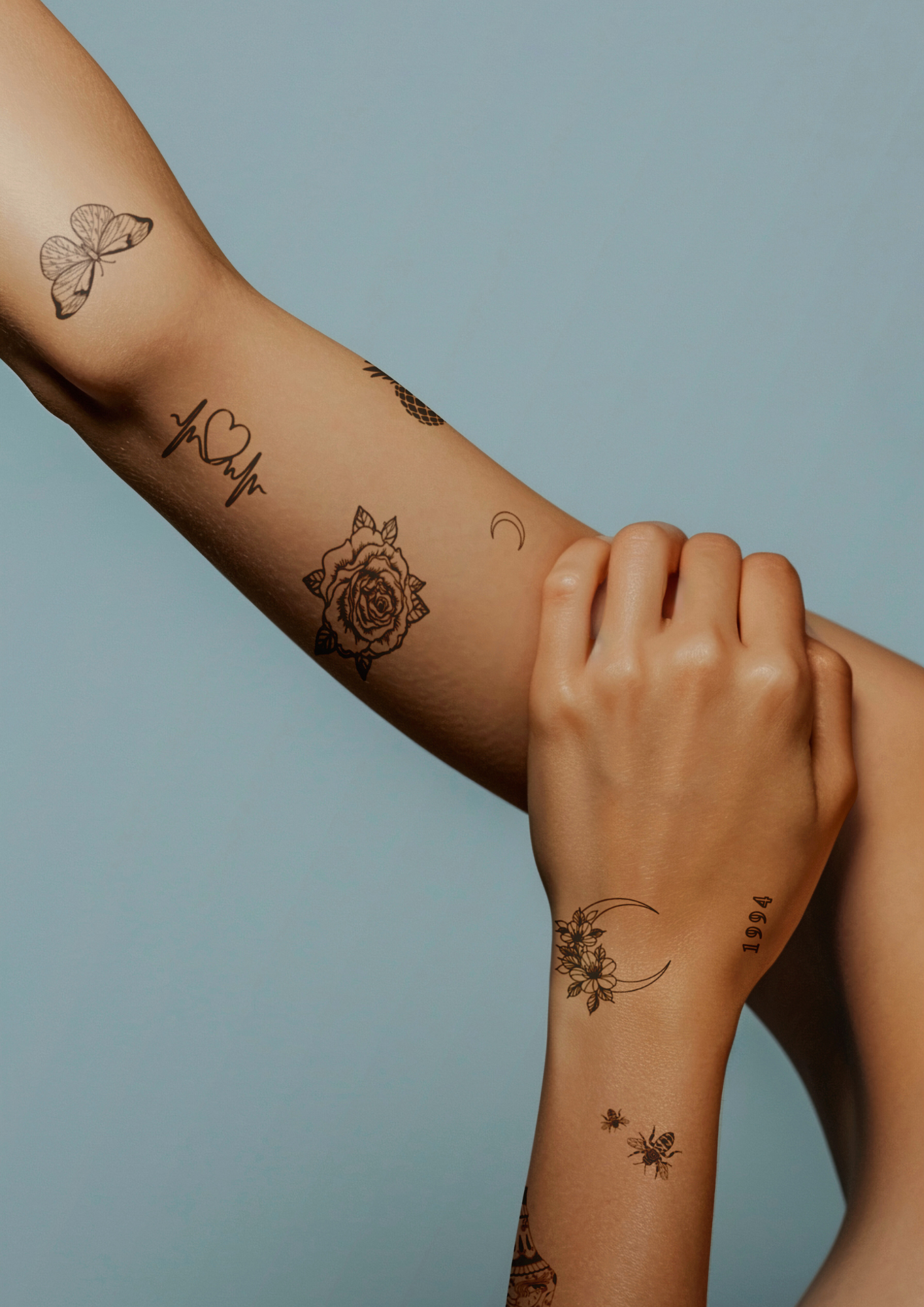


You've been thinking about a tattoo but you're not ready for the permanent kind. Maybe you want to test a design before committing to $200/hour at a studio. Maybe you've got a bachelorette weekend coming up and want something that looks real for the photos. Or maybe you just like the idea of switching up your look without sitting in a tattoo chair for three hours.
That's what semi permanent tattoos are for. And if you haven't heard of jagua yet, this is the part where things get interesting.
Jagua tattoos use a natural fruit-based ink that stains your skin a deep blue-black — the kind of color that genuinely passes for permanent ink. They last 1 to 2 weeks, they're waterproof, and they fade on their own. No needles, no pain, no laser removal. Just body art that works on your terms.
We've been making jagua-based temporary tattoos since 2020, and this guide covers everything: how they work, how to apply them, how long they last, what designs are trending in 2026, and what to realistically expect. No marketing — just the information you need.
What "semi permanent tattoo" actually means
A semi-permanent tattoo is body art that stains the upper layers of skin and fades on its own — typically within 1 to 2 weeks for jagua-based ink. No needles are involved, and nothing is injected: the ink develops in the skin's surface and disappears as your skin naturally renews.
Quick clarification, because this term gets thrown around for a few different things. Some people mean cosmetic procedures like microblading or needle-based tattoos (like Ephemeral) that last months. That's not what we're talking about here.
When we say semi permanent tattoo, we mean a jagua-based temporary tattoo that stains the top layer of your skin and lasts 7 to 14 days. No needles involved. The stain develops over 24 to 48 hours into a blue-black color that looks like real tattoo ink — then fades naturally as your skin regenerates.
Think of it as the sweet spot: realistic enough to fool people, temporary enough to let you change your mind. If you've used water-transfer decals before (the kind that last 2-3 days and look shiny), jagua is a different category entirely. If you've used Inkbox before it shut down — that was jagua technology too.
How jagua works (the short version)
Jagua comes from the fruit of the Genipa americana tree, native to the Amazon. Indigenous communities in South America have used it for body art for over 2,000 years — this isn't some new lab experiment.
The active compound, genipin, binds with proteins in your epidermis (the outermost skin layer). Over 12 to 48 hours, it oxidizes and darkens into a deep blue-black. Because it only affects the outer layer, the stain disappears naturally as your skin cells shed — usually within two weeks.
The result: a tattoo that sits in your skin, not on top of it. That's why it looks so much more realistic than a sticker.
The 2026 landscape: what's changed
If you're researching semi permanent tattoos right now, you should know what's happened in the last year. On February 23, 2026, both Inkbox and Tattly shut down — BIC decided to close its entire Skin Creative division. Inkbox had been the biggest name in jagua-based semi permanent tattoos since 2015. Tattly was the go-to for artist-designed water-transfer decals. Both are gone.
That's left a real gap in the market. If you were an Inkbox customer, the good news is the technology hasn't disappeared — jagua is a natural product, not a proprietary invention. Brands like ours (Temporalis), EasyTatt, Easy.ink, and EZINK all use the same genipin-based approach. We wrote a detailed Inkbox alternative guide and a Tattly alternative breakdown if you're coming from either of those.
Other things worth knowing in 2026: new brands are entering the space (Just Tattoos launched in March 2026), the clean beauty community on TikTok and Reddit has embraced jagua as a PPD-free alternative to synthetic body art, and custom semi permanent tattoos — where you upload your own design — are now a real option. More on that below.
Why jagua is worth your attention
They actually look real
Jagua produces a blue-black tone that's practically identical to permanent tattoo ink. From a few feet away, most people can't tell the difference. Compared to the shiny, obviously-fake look of water-transfer decals, it's a different category. Browse our realistic tattoo collection — all photos are unretouched jagua stains on real skin.
Test before you commit
Curious how a design would actually look on your body? Jagua lets you live with it for two weeks before spending $200+/hour on permanent ink. You'll know if the placement works, if the scale feels right, and whether you still love it after day five. Our arm tattoos and finger tattoos are popular for exactly this reason. And if you have a specific design in mind, you can now upload your own artwork and have it printed in jagua ink — custom, from 3 copies.
Zero pain, zero needles
The sticker goes on your skin, you press with a damp cloth for 30 seconds, peel it off, and that's it. If needles aren't your thing, jagua gives you the look without the experience.
Career-friendly
Some workplaces still care about visible tattoos. Semi permanent tattoos let you get inked on Friday and have it fade naturally by the following week. No awkward conversations with HR, no long-sleeve strategy in July.
Perfect for events
Coachella. Bachelorette weekends. Summer pool parties. Jagua tattoos are waterproof once developed, photograph beautifully, and last through whatever you throw at them. Check out our US festival tattoo guide or matching couple designs if you're planning something specific.
Semi permanent vs permanent vs basic temporary
| Jagua (semi permanent) | Permanent tattoo | Sticker temporary | |
|---|---|---|---|
| Duration | 1-2 weeks | Lifetime | 2-5 days |
| Looks real? | Yes — blue-black, matte | Yes | Visibly fake |
| Pain | None | Moderate to high | None |
| Cost | $10-$40 | $150-$300+/hr | $5-$15 |
| Waterproof | Yes | Yes (once healed) | Sometimes |
| Removal | Fades naturally | Laser ($$$) | Washes off |
| Custom designs | Yes — upload yours | Yes (at the studio) | Yes |
For the detailed breakdown of jagua vs permanent ink (cost per design, pain comparison, aftercare differences), we wrote a full jagua vs permanent tattoo guide. And for jagua vs henna specifically (different colors, different use cases), see our jagua vs henna comparison.
How to apply a jagua tattoo
Whether you're using one of our semi-permanent temporary tattoos — 600+ ready-to-apply designs or going freehand with jagua gel, here's the process.
1. Patch test (24 hours before)
Jagua is natural, but allergic reactions are possible — similar to any fruit-based product. Apply a small amount to your inner forearm, leave 2-3 hours, then check over the next 24 hours. Any redness, itching, or bumps? Skip the full application.
2. Prep your skin
Exfoliate gently the day before. On application day: wash with soap and water, wipe with rubbing alcohol to remove oils, let it dry completely. Leftover lotion, oil, or moisture will block the stain.
3. Apply
For sticker designs: place on clean skin, press with a damp cloth for 30 seconds, peel off. For gel application: apply in a smooth, even layer using an applicator or stencil. The gel goes on greenish-blue — that's normal.
4. Wait
Sticker designs: keep dry for 1-2 hours. Gel application: leave the gel on for 2-6 hours (the longer, the darker). Some people apply gel in the evening and sleep with it on — use medical tape to protect it overnight.
5. Rinse and wait for the reveal
Peel or wash off the residue. You'll see a faint gray-blue mark. Don't panic — the color develops over 24-48 hours as genipin oxidizes. The deep blue-black you see at 48 hours is your real result. This is the moment that makes people double-take.
How to make it last (and how to remove it early)
First 48 hours (the critical window): Minimize water exposure — the stain is still developing. Quick showers are fine; long baths, pools, and hot tubs are not. Skip the lotion until the color has fully set. No gym — sweat during development can lighten or patch the stain.
Days 2-14: Moisturize daily with coconut or jojoba oil. Pat dry after washing (don't rub). Avoid exfoliating products on the tattooed area. Limit pool and ocean time — chlorine and salt water accelerate fading.
Need it gone sooner? Exfoliate 2-3 times a day with a gentle scrub. Hot baths help. Chlorinated pools are surprisingly effective. Lemon juice or baking soda paste can speed things up. Plan for 3-5 days of consistent effort — don't scrub aggressively or you'll irritate your skin before the tattoo fades. For a deeper dive on duration and placement, read our complete duration guide.
Best placements
Jagua stains darker on thicker skin with more protein. Placement matters — a lot.
Darkest, longest lasting: Hands and fingers (thick skin = dark stain, but fades faster from washing), feet and ankles, forearms (consistently great), and wrists (ideal for minimalist designs).
Good results: Shoulders and upper back, chest and collarbone, calves.
Lighter results: Inner arms (thinner skin), torso and stomach, behind the ear.
Popular designs in 2026
The best thing about temporary ink: you can follow trends without worrying about whether you'll still love it in 2035.
Botanical fine-line — Wildflowers, single stems, trailing vines. Thin, precise linework that looks incredible on wrists, ankles, and collarbones. From roses to lotus flowers to cherry blossoms.
Minimalist symbols — Tiny hearts, moons, stars, arrows. Small, stackable, and perfect for testing placement on fingers and wrists.
Zodiac and celestial — Constellation maps, astrology glyphs, moon phases. Massive on TikTok. Every sign covered in our collection.
Butterflies — Having a moment right now, from festival looks to everyday ink. Collarbone, wrist, ankle — all work.
Matching designs — Same design, your whole crew. Friends, partners, siblings. The semi permanent version of friendship bracelets.
Your own design — Upload any artwork — a logo, a drawing, a date, a name — and we print it in real jagua ink. Custom tattoos from 3 copies. This is what Inkbox's custom feature used to do, and it's now available through our configurator.
Browse the full catalog of 600+ designs →
Safety: what you should know
Jagua is natural and generally safe, but it's something you're putting on your skin, so here's the honest picture.
Always patch test — 24 hours before, on a small area. Non-negotiable.
Be cautious if you have: tropical fruit allergies (berries, kiwi, strawberry), sensitive skin or eczema. As a precaution, ask your doctor for advice if you are pregnant or breastfeeding.
Jagua is NOT "black henna." Black henna contains PPD, a toxic chemical that causes burns, scarring, and permanent allergic sensitization. Jagua is a fruit extract. Completely different product, completely different risk profile. Full breakdown: black henna dangers guide.
What a jagua reaction looks like (rare): Mild redness, itchy rash, small bumps at the application site. Unlike PPD burns, jagua reactions are temporary and resolve within a few days. Remove any remaining gel, wash the area, and see a doctor if symptoms persist.
For the comprehensive safety guide with medical sources, read our jagua safety article.
Jagua gel: the DIY option
Everything above applies to our ready-to-apply sticker designs. But if you want to draw freehand, use stencils, or create your own body art from scratch, we also sell jagua gel — the same ink in a tube or pouch that you apply yourself.
Three formats: a 10 ml tube for trying it out (~8 tattoos, applicator included), a 100 ml refill pouch for regular users (~80 tattoos), and a 1 liter pro pouch for artists and events (~800 tattoos). Same formula, same stain, different volumes.
Frequently asked questions
How long do semi permanent tattoos last?
7 to 14 days depending on placement, skin type, and aftercare. Arms and shoulders last longest. Hands and fingers fade faster from washing. Full duration guide →
Do semi permanent tattoos look real?
Yes — jagua produces a deep blue-black with a matte finish that genuinely passes for permanent ink at a normal viewing distance. It stains the skin cells themselves, not just the surface.
What happened to Inkbox?
Inkbox shut down in February 2026 when parent company BIC dissolved its Skin Creative division. As of July 2026 the site shows strong pre-launch signals (email sign-up, staged product pages) but sales haven't reopened. Full Inkbox story + alternatives →
Can I design my own semi permanent tattoo?
Yes. Upload your design — a logo, a drawing, a name, anything — and we print it in real jagua ink. Custom orders from 3 copies. This is the same concept as Inkbox's custom feature.
Are semi permanent tattoos safe?
Jagua is a natural fruit extract — no PPD, no synthetic dyes, no needles. Allergic reactions are rare but possible. Patch test 24 hours before. Jagua is NOT "black henna." Full safety guide →
What's the difference between jagua and henna?
Jagua = blue-black (looks like real ink). Henna = reddish-brown. Both natural, both temporary. If you want it to look like a real tattoo, jagua is the one. Full comparison →
Can I remove a semi permanent tattoo early?
Yes, but it takes 3-5 days. Exfoliate regularly, take hot baths, swim in chlorinated water. Lemon juice and baking soda paste help. Be patient — aggressive scrubbing irritates skin before it removes the stain.
Can I swim or work out with a jagua tattoo?
Wait 48 hours (while the color develops). After that, you're good — it's completely waterproof. Frequent swimming and gym sessions will accelerate fading slightly, but it won't wash off.
Why isn't my tattoo dark enough?
Most common reasons: gel wasn't left on long enough (aim for 4-6 hours), the skin was too thin in that area, water exposure during the development window, or the gel was old. Fresh jagua + patience = best results.