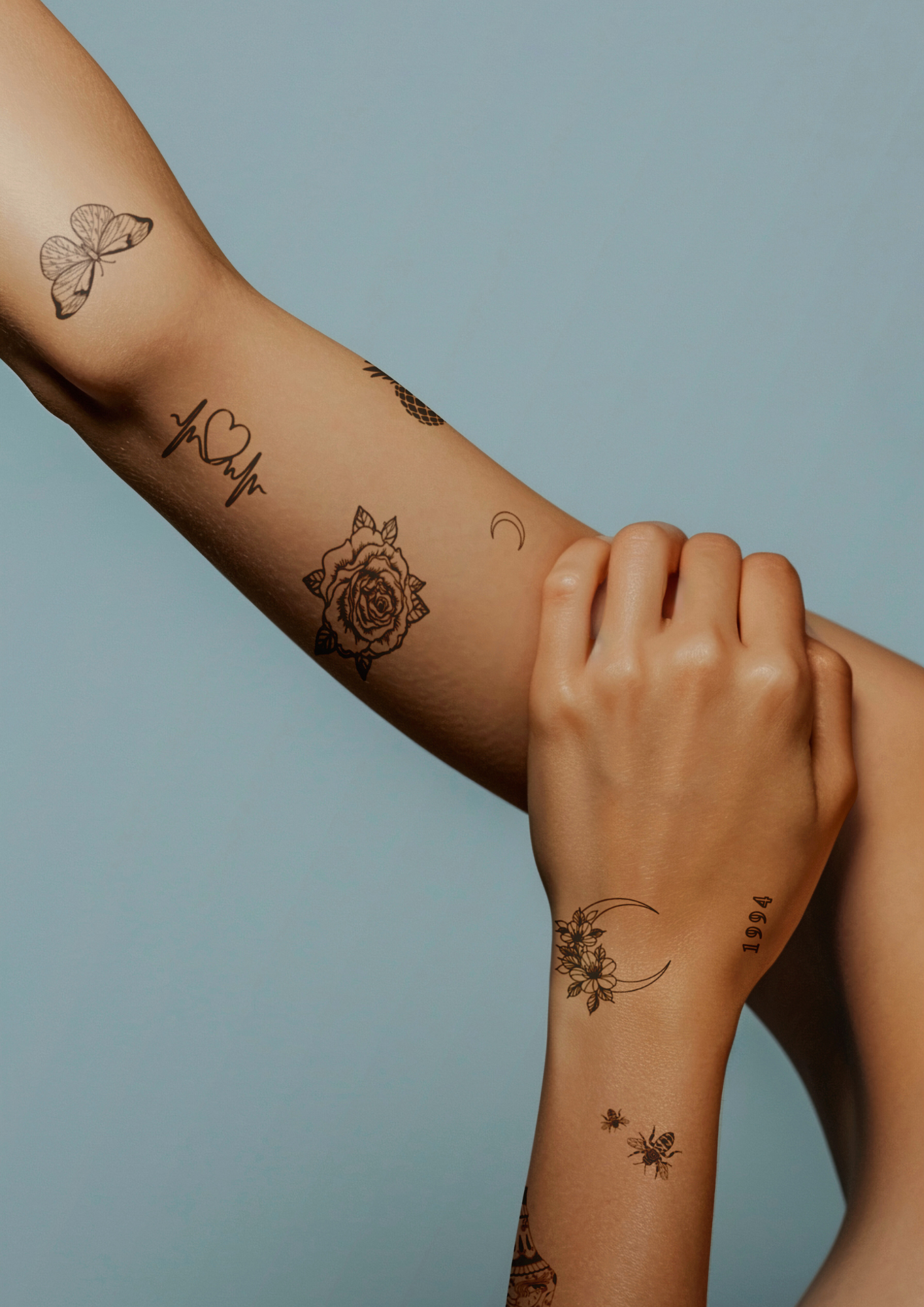
If you've ever searched for temporary tattoos and wondered whether they'd actually show up on your skin, you're not alone. For years, temporary tattoos were basically designed for one skin tone. Water-transfer decals? Practically invisible on dark skin. Henna? Beautiful, but the reddish-brown barely registers on deep complexions.
Jagua is different. And not in a "works on all skin tones!" marketing kind of way. Jagua ink has been used on dark skin for over 2,000 years by indigenous communities in the Amazon — the Emberá, the Wounaan, the Shipibo-Konibo. People with naturally melanated skin who've been decorating their bodies with jagua since long before anyone called it a "temporary tattoo." This isn't a product made for light skin that happens to also work on dark skin. It's the opposite.
So — do jagua tattoos work on dark skin? Yes. Here's exactly what to expect.
The myth that temporary tattoos don't work on dark skin
Let's address it directly, because it comes up a lot.
The tattoo industry — permanent and temporary — has historically been built around lighter skin tones. Artist portfolios that only show work on white skin. "Skin-tone" product shades that stop three shades deep. Temporary tattoo brands whose photos never feature a single Black or brown person. If you've felt invisible in this space, that's not your imagination — it's a real gap the industry is finally catching up on.
The reality is that jagua has always worked on dark skin. The problem was never the ink — it was who the products were being marketed to and whose skin was being represented. The Emberá people of Panama and Colombia have used jagua to create striking geometric body art on their naturally dark skin for centuries. The science is simple: genipin bonds with skin proteins regardless of melanin content. The stain develops in the same skin layer on everyone.
Will the contrast look different on Fitzpatrick Type II skin versus Type V or VI? Of course. But "different" doesn't mean "less than" — and that's the whole point.
What jagua actually looks like on dark skin

Jagua produces a deep blue-black stain by bonding with the proteins and amino acids in your skin's outer layer. The active compound — genipin, from the Genipa americana fruit — oxidizes over 24 to 48 hours into a color that closely resembles permanent tattoo ink.
On dark and brown skin, that blue-black reads as a rich charcoal with a subtle blue undertone. Think of it like the difference between matte black and glossy black — on melanated skin, jagua has a sophisticated, graphic quality you don't get from anything else. The contrast is more subtle than on fair skin, but it's there — clean, defined, and visible.
Here's how jagua reads across the Fitzpatrick scale:
| Skin tone (Fitzpatrick) | Jagua color | Contrast level | Best for |
|---|---|---|---|
| Type I-II (fair / light) | Deep blue-black | High — crisp, sharp details | Fine lines, micro scripts, delicate designs |
| Type III (medium / olive) | Inky blue-black | High to medium — very tattoo-like | Any design — the "sweet spot" for realism |
| Type IV-V (brown) | Rich charcoal with blue undertone | Medium — sophisticated, graphic | Bold designs, geometric, mandala, florals |
| Type VI (deep / dark brown) | Dark charcoal blue-black | Subtle but defined | High-saturation designs, larger scale, strong shapes |
Why jagua works when other temporary tattoos don't

The big issue with most temporary tattoos on dark skin comes down to where the color sits. Water-transfer decals are a thin layer of pigment on top of the skin — usually with a slightly waxy or shiny finish. Against melanated skin, that surface contrast almost disappears.
Jagua is different. The genipin pigment penetrates the outer skin layer (the stratum corneum) and bonds with skin proteins. The color isn't on your skin — it's in your skin. That's why it reads like real tattoo ink, regardless of your starting skin tone. Same physics as a permanent tattoo, just at a different depth that fades naturally over 1 to 2 weeks.
If you've used Inkbox before it shut down in February 2026, that was jagua technology. The tech works. We're just continuing the tradition.
The best designs for dark skin
Some designs perform better than others on melanated skin. The pattern: bold, high-contrast, intentional space. Not a limitation — just physics. Here are the styles that hit hardest.
Geometric and mandala designs

Geometric and mandala designs are the natural fit. Sharp lines, symmetrical patterns, intentional negative space — they create their own contrast within the design itself, which works regardless of how the skin contrasts with the ink. The eye reads the structure first, the color second.
Bold florals

The trick with florals on dark skin is to lean bold. Strong outlines, full saturation, large-format roses or peonies. Skip ultra-fine line work and dotwork stippling — they tend to muddle. Go for designs that read clearly from across the room.
Symbols and graphic art
Symbols, sigils, and graphic art work brilliantly. Anything with a strong silhouette — moons, suns, stars, hands, eyes. Solid black-fill graphic styles are basically made for melanated skin. They don't rely on contrast against the skin — they're statements in their own right.
Minimalist designs (yes, they work too)
Minimalist doesn't have to mean tiny. A small, clean script on the inner forearm or a single bold line across the collarbone reads beautifully on dark skin. The key is intentional simplicity — every element does work. Skip designs with multiple ultra-fine details that compete for visibility.
Best placements for jagua on dark skin

Best placements (longest wear, strongest contrast)
Inner forearm, upper arm, outer thigh, collarbone, and upper back. These are areas with thicker skin and lower friction — jagua stains darkest there and the design holds for the full 1-2 weeks. The collarbone in particular gives a clean canvas for graphic, jewelry-adjacent designs.
Trickier placements (still works, but fades faster)
Hands, fingers, ankles, and inner wrists fade faster on every skin tone, but on dark skin the trade-off is more noticeable: faster fade plus subtler contrast. Possible, but plan for 5-7 days of strong color rather than the full 14.
How to get the richest, darkest result
Before you apply
Exfoliate the area gently the night before. Wash with soap and water on application day, then wipe with rubbing alcohol to remove oils. Any leftover lotion, oil, or moisture blocks the stain. Skin should be clean, dry, and matte before the gel touches it.
During application
Apply the gel in a smooth, generous layer — thicker is better on dark skin. The gel goes on greenish-blue (that's normal). Leave it on for the full recommended time, then add an extra 30-60 minutes if you can. Saturation is what gets you the deep result.
The 48-hour rule
This is the single most important thing for melanated skin: do not judge the color before 48 hours. At hour 1, the design will look faint gray. At hour 6, light blue. At hour 24, you'll see a real blue-black. At hour 48, the rich charcoal that's your actual final color. People who get disappointed with jagua on dark skin almost always made the call too early.
Aftercare for maximum longevity
No water for the first 24 hours. After that, keep it moisturized — dry skin exfoliates faster, which fades the stain faster. Skip swimming pools, hot tubs, and aggressive scrubs for the first 5 days. Pat dry instead of rubbing. Full duration guide →
Common mistakes to avoid on dark skin
- Judging the color at hour 12. The single biggest mistake. The stain takes 48 hours to fully oxidize. Your final color is not your day-one color.
- Applying the gel too thin. On melanated skin, saturation matters more than on fair skin. Generous layer, full coverage, longer wear time.
- Choosing ultra-fine designs. Hairline scripts and stippling get lost. Bold lines and high-contrast shapes win every time.
- Using "black henna" to get a darker stain. "Black henna" is henna mixed with PPD — a chemical that causes severe allergic contact dermatitis, blistering, and permanent scarring. The FDA warns against it specifically. Jagua is the only natural product that delivers a real blue-black. Full breakdown of black henna risks →
- Scrubbing it off too early. Friction during the first 5 days fades the stain dramatically faster. Pat dry, don't rub.
- Ignoring post-inflammatory hyperpigmentation risk. Melanated skin is more prone to PIH around any skin trauma — even temporary stains. This isn't a jagua-specific issue, but it's why aftercare matters: keep the area moisturized, protect from sun, avoid friction.
Jagua vs henna on dark skin
If you've tried henna and felt disappointed with the visibility on your skin, you're not alone. Henna stains a reddish-brown — a beautiful color, but one with very little contrast against brown and dark skin tones. On deep skin, henna can practically disappear within a few days.
Jagua stains blue-black. Completely different part of the color spectrum, completely different result on melanated skin. Side-by-side:
| Method | Stain color | Visibility on dark skin | Looks like real ink? | Duration |
|---|---|---|---|---|
| Jagua | Blue-black / charcoal | High — clear contrast | Yes — close to permanent | 7-15 days |
| Henna | Reddish-brown / orange-brown | Low — often hard to see | No — distinctly henna-like | 7-14 days |
| "Black henna" (PPD) | Dark / black | High — but DANGEROUS | Yes — but causes burns and scarring | Permanent damage possible |
For the full breakdown: jagua vs henna full comparison.
What it costs
Jagua sticker designs start at $9 for smaller pieces and run $15-25 for medium-large formats — same price regardless of skin tone (because we don't gatekeep color visibility). The 100ml jagua gel pouch ($45) covers about 80 tattoos and gives you full control over saturation, which is genuinely useful on melanated skin.
Compared to a permanent tattoo at a US studio ($150-$500+ for a small-to-medium piece, plus $0-$2000 if you ever want it removed via laser — and laser tattoo removal on dark skin requires specialized Q-switched Nd:YAG equipment many studios don't have), jagua lets you test commitment for under $20.
What the community is saying
If you want unfiltered before/after photos and real-talk reviews from people with melanated skin, search r/blacktattoo on Reddit for jagua threads, or check the #darkskintattoo hashtag on TikTok (200M+ views, with a strong jagua subset). Both are unfiltered communities where the photos haven't been retouched for the brand. If you want to see how jagua actually develops on Type V-VI skin, those are your sources.
Designs our customers love

If you're not sure where to start, the most popular collections for our melanated-skin customers are geometric tattoos, mandalas, symbols, and bold florals. Browse the full catalog if you want to scroll everything.
See it for yourself
We know that for a lot of people, the only way to truly believe it is to see it on your own skin. Here's what we'd suggest:
Try one design. Pick something from our bestsellers or our small tattoo collection — something you're excited about. Apply it, wait the full 48 hours, and see how the color develops on your skin. Most people are genuinely surprised by how dark and defined the stain gets.
Share your result. If you love how it looks, tag us @temporalis.tattoo with #TemporalisOnDarkSkin — we're actively building a gallery of real jagua results on every skin tone, and your photo could help someone else see what's possible.
And if you've been on the fence because you've been burned (literally or figuratively) by temporary tattoos that didn't work for you before — we get it. Jagua is different. It was made for your skin from the start.
Frequently asked questions
Do jagua tattoos show up on dark skin?
Yes. Jagua's blue-black pigment bonds with skin proteins regardless of melanin content — the same chemistry, in the same skin layer, on every skin tone. The contrast reads more subtly on Type V-VI skin than on Type I-II, but it's clean, defined, and unmistakable when you give it the full 48 hours to develop.
How long do jagua tattoos last on dark skin?
The same 7-15 days as on any other skin tone. Duration depends on placement, friction, and aftercare — not on melanin. Hands and feet fade faster everywhere; forearms and shoulders hold longest everywhere.
Is jagua safe for melanated skin?
Yes. Jagua is a natural fruit extract, EU cosmetic-certified, with no PPD, no PTDS, and no synthetic dyes. Allergic reactions are rare but possible — patch test 48 hours before, especially if you have tropical fruit allergies (kiwi, papaya, mango, pineapple). Melanated skin is slightly more prone to post-inflammatory hyperpigmentation around any skin trauma, so good aftercare matters.
What designs work best on dark skin?
Bold, high-contrast designs with intentional negative space. Geometric, mandala, bold florals, symbols, and graphic blackwork all hit hard on melanated skin. Skip ultra-fine line work, dotwork stippling, and tiny multi-element designs — they tend to muddle.
Jagua vs henna on dark skin — which is better?
Jagua, by a wide margin. Henna's reddish-brown stain has very low contrast against brown and dark skin and often disappears within a few days. Jagua's blue-black gives clear, tattoo-like definition that reads as real ink across all skin tones.
What about "black henna" — is that the same as jagua?
No, and please don't confuse them. "Black henna" is henna mixed with PPD (para-phenylenediamine), a chemical that causes severe allergic contact dermatitis, blistering, chemical burns, and permanent scarring. The FDA warns against it specifically. Jagua is a 100% natural fruit extract with none of those risks. Full breakdown →
Can I use jagua during pregnancy?
Jagua has been used by indigenous communities including pregnant women for centuries, and it's a natural fruit extract with no synthetic chemicals. Most healthcare providers consider it safe, but always check with your OB-GYN first and patch test 48 hours before application.
Do you ship to the US?
Yes. Free US shipping over $75. Standard delivery in 5-8 business days from our European warehouse. Orders are processed Monday-Friday.

Real ink. Every shade.
Pure jagua gel — the same Genipa americana extract used by indigenous communities for 2,000 years. Works as designed across all Fitzpatrick types.
Free US shipping over $75 · ~8 tattoos per pouch