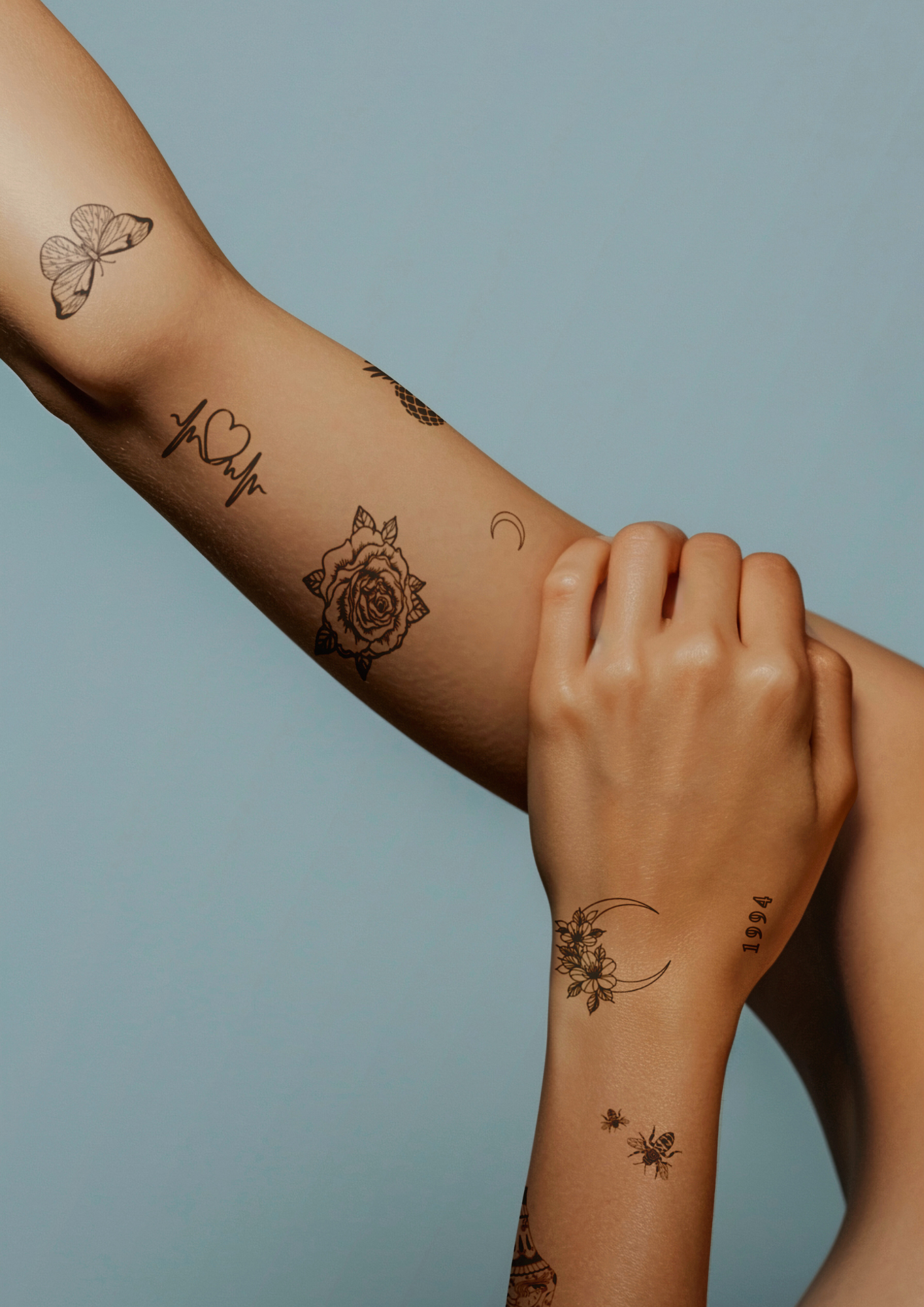


Between 1 and 15 days. The gap is that wide because "temporary tattoo" covers four very different techniques, and each behaves differently on skin.
Here are the real numbers by type, what placement does to them, how they stack up against the brands you have probably already looked at, and why anything promising several months either involves a needle or is not telling you the truth.
Duration by type
| Type | How long | How it works |
|---|---|---|
| Jagua | 7 to 15 days | Fruit dye that stains the epidermis. Blue-black, fades with skin renewal |
| Henna | 1 to 2 weeks | Plant dye too, but reddish-brown. Can be topped up |
| Water transfer | 2 to 5 days | A printed film sitting on the skin |
| Waterproof cosmetic ink | 3 to 7 days | Surface ink, tougher than a standard transfer |
| Airbrush | 2 to 7 days | Sprayed pigment, stays on the surface |
How the big names compare
If you have been shopping around, you have met the same three brands. Here is where they land, using their own published figures.
- Inkbox shut down in February 2026 when BIC closed its Skin Creative division, and has since relaunched. Its For Now Ink is a jagua-family ink, and the brand now states up to 10 days.
- Momentary Ink uses a water-transfer style product and puts its own range at up to two weeks with careful aftercare, which is optimistic for a film-based tattoo.
- Ephemeral is a different category entirely: applied with needles by tattoo artists, ink placed under the skin, designed to break down over months to around three years by the brand's own account.
The useful takeaway is that everything needle-free clusters in the same one-to-two-week window, whatever the branding. Ours sits at 7 to 15 days. Nobody in this category is going to give you a month.
Still looking for Inkbox specifically? We wrote up what happened and what to use instead.
Why the gap is so wide: stains versus films
One distinction explains the whole table. Some techniques stain the skin, others sit on it.
A stain, like jagua or henna, reacts with the proteins in your epidermis. The color forms inside the surface cells, so it only leaves when those cells shed, which takes roughly two weeks. A film, like a water transfer or airbrush, is pigment resting on top. It starts breaking down at the first shower and gives up to friction long before your skin renews.
Inkbox's own team once put it as a hair-dye analogy, and it holds: temporary dye sits on top and rinses out, semi-permanent dye sinks in and changes the color from within. Same logic on skin. Which is why no aftercare trick gets a sticker to two weeks. If duration is what you care about, the technique decides almost everything before you even apply it.

"But I read about tattoos that last six months"
You did, and it is worth being clear, because plenty of pages repeat it.
Nothing applied to the surface of your skin lasts months. Two weeks is the physical ceiling, because that is how long your epidermis takes to renew itself. Anything sold as a needle-free tattoo lasting six months or a year is either mislabelled or misdescribed.
What genuinely lasts longer always involves a needle:
- Made-to-fade tattoos such as Ephemeral: a real tattoo process, needles, ink placed under the skin, designed to break down over 9 to 15 months.
- Cosmetic semi-permanent work such as microblading, lip and eyeliner: needles again, 1 to 3 years.
Both are procedures rather than cosmetics. Different price, different commitment, different regulation. If someone offers months of wear with no needle and no appointment, the promise is inflated, and occasionally the reason it holds longer is an ingredient you would rather not have on your skin.
Wanting the look without the needle is completely reasonable. The honest answer is one to two weeks, and it is worth planning around that rather than around a claim. If the vocabulary is what is confusing you, we untangle it in our guide to what semi-permanent actually means.

Two weeks, and we say two weeks.
Our designs are real jagua ink: they stain the skin instead of sitting on it. Blue-black like a needled tattoo, waterproof once developed, gone on their own after 1 to 2 weeks. No needles, no appointment, no laser.
Free shipping over $75 · Dermatologist tested
What placement changes
Placement does not raise a technique's ceiling. It decides whether you land at the top or the bottom of its range, and the spread is wide enough to matter.
| Area | Jagua | Water transfer |
|---|---|---|
| Low friction Outer upper arm, bicep, shoulder blade, calf, upper back |
12 to 15 days | 4 to 5 days |
| Medium Inner forearm, thigh, ribcage, ankle, collarbone |
8 to 12 days | 3 to 4 days |
| High friction Hands, fingers, wrists, neck, waistline, feet |
4 to 7 days | 1 to 2 days |
The wrist surprises people most. It looks like a flat, safe spot, but it rubs against sleeves, desks and surfaces all day and gets washed with every hand wash. A design there runs at the bottom of its range whatever technique you choose.

What shortens it, whatever you chose
Friction first: tight sleeves, bag straps, waistbands, sport. Then long soaks, chlorine and hot water, which soften the outer layer of skin. Then anything abrasive: scrubs, exfoliating mitts, oil-based cleansers. Sun fades a stain faster and lifts a film sooner.
None of it is dramatic and most of it is avoidable. The full method is in our guide on how to make a temporary tattoo last longer.
Choosing by occasion
A weekend, a party, a shoot. A water transfer is enough, and it comes off easily afterwards.
A festival or a week away. You need something that survives sweat, sun and swimming. Jagua, applied two days before you leave, since the color takes 24 to 48 hours to develop.
Testing a design before permanent ink. Jagua. Two weeks of ordinary life with the design at real size is the only honest test, and nothing shorter tells you anything.
An event on a fixed date. Whatever you pick, apply it two days ahead, not on the morning. This is the single most common reason people end up disappointed.
One safety note
If someone offers you a "black henna" tattoo that turns jet black within minutes, refuse it. Real henna is reddish-brown and takes hours. Instant black means PPD, a hair-dye chemical the FDA has not approved for direct application to skin, which causes severe reactions and sometimes lasting scarring. Jagua is blue-black, takes 24 to 48 hours, and contains none. Full detail in our guide to the dangers of black henna.
Frequently asked questions
How long do temporary tattoos last?
Between 1 and 15 days depending on the technique. Water transfers last 2 to 5 days, waterproof cosmetic inks 3 to 7, henna 1 to 2 weeks and jagua 7 to 15 days. Placement then decides whether you land at the top or the bottom of that range.
Which temporary tattoo lasts the longest?
Jagua, at 7 to 15 days. It stains the top layer of skin rather than sitting on it, so it only goes when your skin renews. Anything printed on a film comes off far sooner.
Do temporary tattoos that last months exist?
Not without a needle. Two weeks is the physical ceiling for anything applied to the surface, because that is how fast your epidermis renews. Made-to-fade tattoos like Ephemeral do last 9 to 15 months, but they are applied with needles and are a tattooing procedure, not a cosmetic. Cosmetic semi-permanent work such as microblading lasts 1 to 3 years, also with needles.
How long does a temporary tattoo last on the wrist?
Less than almost anywhere else. The wrist rubs against sleeves and surfaces all day and gets washed constantly. Expect the bottom of the range for whatever you chose: 4 to 7 days for jagua, 1 to 2 for a water transfer. For maximum wear, move up to the outer upper arm.
Are temporary tattoos waterproof?
Jagua is, once the color has developed: shower, swim and train normally. Water transfers are water-resistant at best and do not survive long soaks. In every case, repeated soaking and rubbing shorten the wear.
How long before an event should I apply one?
Two days for jagua, because the color needs 24 to 48 hours to reach full blue-black. A water transfer can go on the same day. Applying jagua on the morning of an event is the most common mistake we see.
Next: how to make yours last longer · what semi-permanent really means · what jagua is · browse all designs · jagua gel for freehand